From the Newsletter
From Torque to TORC
Tokens Measure What You Spent. TORC Measures What You Made.

Two weeks ago I wrote that tokens are becoming money. Not the metaphorical kind. A Claude token is not the same as a Gemini token, and the real rate was never dollars per million tokens. It is dollars per useful answer, dollars per decision you trust enough to act on.
The best part of publishing that idea was watching it get sharper in the comments.
Sean McMahon, a professor at Elon University, took the idea somewhere I had not. (Sean and I once bootstrapped a startup by loading UPS trucks on the 2am shift in Atlanta. He has been pricing effort for a while.)
He started with labor-hours, a unit that sounds standard and never was. An hour of skilled labor and an hour of unskilled labor share a name and almost nothing else. Then he reached for fusion. Livermore made news by hitting net energy gain... more energy coming out of the reaction than the lasers put in. So he asked whether tokens need the same test. A stable currency of action, where a token only counts at compute break-even or better.
In physics there is a number called critical torque. It is the exact amount of force where a stuck thing finally moves. Below that number you are straining against a lever that does not budge. You are spending effort. Nothing is happening.
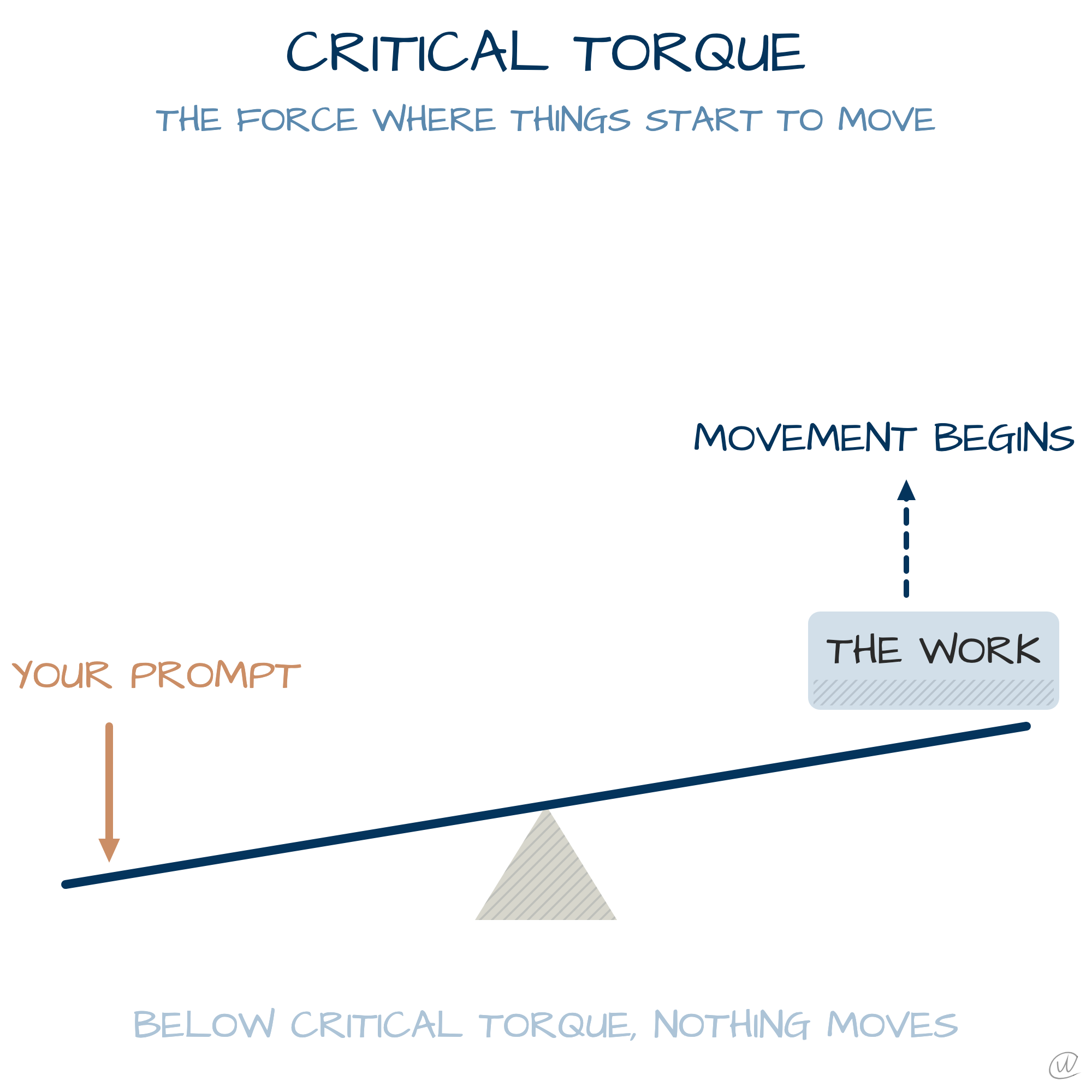
A torc, Sean pointed out, is also the ancient Celtic neck ring, twisted from gold, silver, or bronze. It shares a root with torque because of how it was made. Force, twisted into an object you can hold.
His takeaway line was better than mine.
"You may apply torque to something, but you don't actually get torc unless you create something of interest or usefulness."
Burning tokens is applying torque. Torc is when something moves.
We riffed it into a definition across a few replies. I offered outcome, relative, and compute. Sean swapped my "total" for "tangible," because aggregate output is torque again. What you want is output in the shape you asked for.
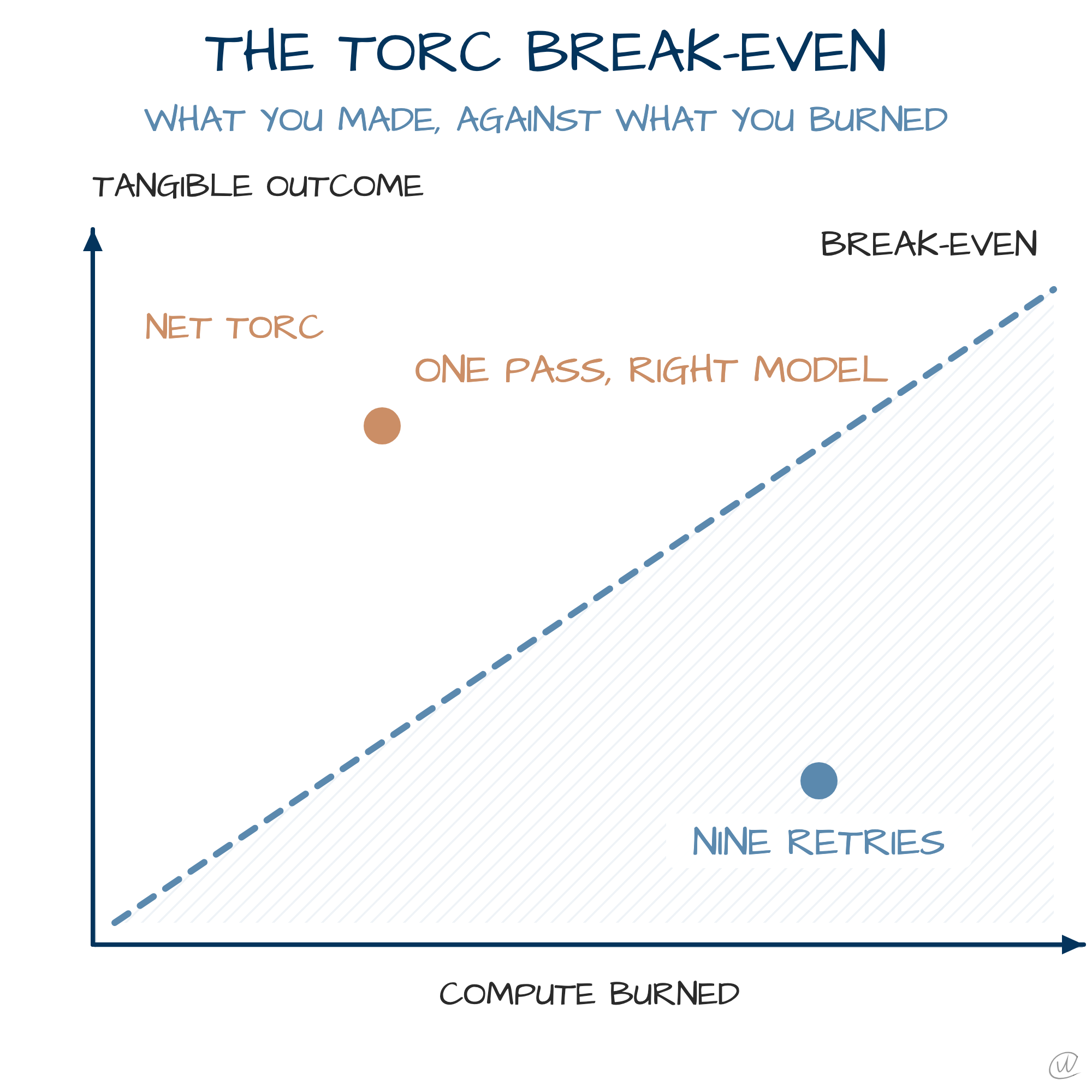
T.O.R.C. Tangible Outcome Relative to Compute.
It is a ratio. Compute sits in the denominator... every token you burned across every retry and every review cycle a human ran because the first answer could not be trusted. The tangible outcome sits on top. The thing that shipped, the decision you acted on.
Run the math that way and a cheap model can get expensive fast. Nine retries on a discount model can buy less TORC than one pass on a frontier model that lands the answer. The dollars-per-million-tokens sticker tells you none of this. The ratio does.
If tokens were a stable currency, none of this would be urgent.
Anthropic shipped Claude Fable 5 in June. Export controls pulled it offline for eighteen days, access came back this week, and now it leaves the subscription plans after July 7th... restored as a standard part of them whenever capacity allows.
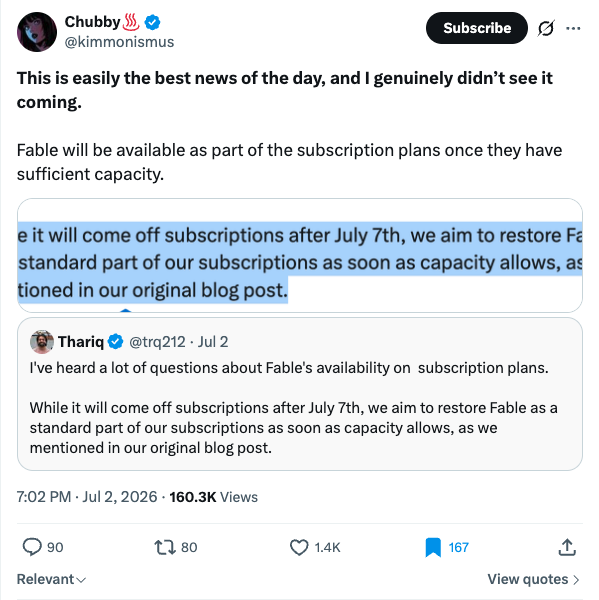
Same model. Same tokens. In under a month the purchasing power of a Fable token changed three times, and the list price never moved. The rate was floating on capacity and access the whole time.
A floating currency you do not control is a strange thing to build your company on. Which is exactly the nerve Palantir just hit.
Alex Karp is out telling enterprises that the AI labs oversold their models and pushed tokenmaxxing, and that customers should own the full stack with Palantir and NVIDIA at the center.
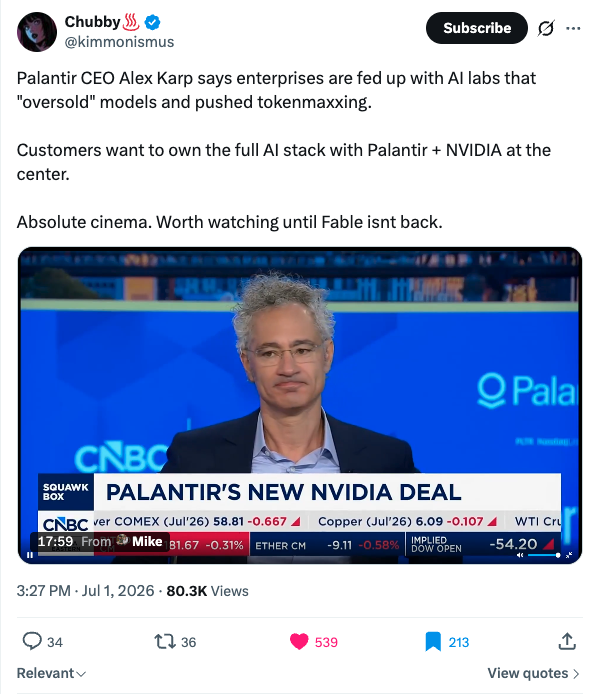
Tokenmaxxing is torque with no TORC. But the pitch goes further than cost. Palantir's own sovereignty statement puts it in one line, "Sovereignty is the precondition for choice." Give it up, and the future choices of your institution belong to whoever runs the meter.
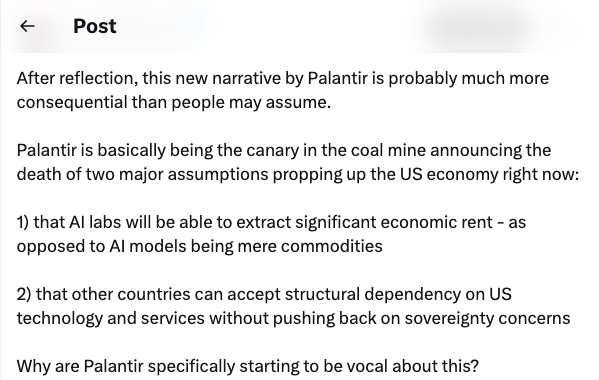
Arnaud Bertrand read the move as a canary in the coal mine. In his telling, Palantir is announcing the death of the assumption that AI labs can extract rent on tokens at all... open-source alternatives run at roughly a tenth of the price, and the premium buys you zero control over your data or the model. He also calls the pitch self-serving, which it is. Two days after the broadside, Palantir and NVIDIA launched exactly the alternative they were arguing for. Open models on NVIDIA hardware, running in sovereign environments.
Money is only half of that trade. Every prompt your teams send an external model, every output they build on, every workflow it quietly learns... that is your tribal knowledge running through someone else's pipes. You pay for the compute going in. You leak the IP coming out.
This is why internal tokens on internal models are where a lot of enterprise usage has to go, and why NVIDIA keeps signing partnerships that bring the hardware and the models in house. An internal token is minted on your own gear, against a model you control, fed by data that never leaves. Weaker on some tasks, yours on all of them.
In the Token Exchange post I said token management is starting to look less like SaaS admin and more like treasury. A treasury desk manages exchange rates. An exchange rate has two sides. What a token costs you, and what it converts into. TORC prices the conversion, and the desk quotes two rates.
The external rate is what a frontier token converts into for your work. On hard, novel problems it buys the most TORC per token of anything on the market. It also floats. Someone else sets the price, the access, and the capacity... the Fable weeks all over again. And part of what you pay walks out the door as IP.
The internal rate is what a token minted on your own hardware converts into. The raw model is often weaker. But the denominator is capex and power instead of someone else's margin, nothing leaks, and the rate improves over time, because your data and your context keep tuning the model toward your actual work.
Measured in tokens, the desk's job is just spend less, and that is how a support team gets rationed out of the one model that would have closed the ticket in a single pass. Measured in TORC, the job is routing. The novel high-stakes work goes to the external rate, the repeatable work that touches your IP to the internal one. Count what shipped against what it cost, either way.
That routing is the job of an orchestration layer. It buys TORC at the best available rate, from whichever mint offers it.
The Celts did not wear raw gold. They twisted it into something you could point to, and the twisting is where the value lived. Anyone can burn the metal. Pay for what got made.
Get More Where This Came From
Weekly AI frameworks and data strategy for people who have to make the call.