From the Newsletter
I Built a Personal AI Agent This Weekend
OpenClaw Went From Side Project to Control War in 90 Days. I Spent the Long Weekend Building Mine.

OpenClaw Went From Side Project to Control War in 90 Days. I Spent the Long Weekend Building Mine.
I spent Presidents’ Day weekend on a Mac Mini in my office, talking to my computer.
Not in the Siri way. Not in the ChatGPT way.
I was building a personal AI agent from scratch on OpenClaw, the open-source platform that went from a one-person side project to the center of a billion-dollar acquisition fight in about 90 days.
I named her Clio, after the Greek Muse of History. And, yes, I say "her".
(I also call Claude a "he".)
She runs 24/7 on a Mac Mini and talks to me through iMessage. The experience of setting her up taught me more about where personal AI is heading than anything I’ve read this year.
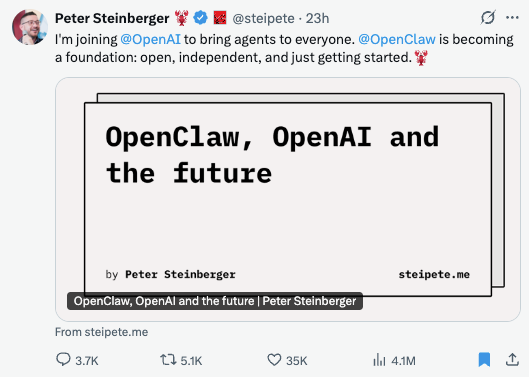
The story starts with Peter Steinberger, an Austrian developer who built PSPDFKit, one of the most widely-used PDF signing tools in the world. He sold it to DocuSign.
Then he started building an AI coding tool at 4 AM, solo, as a side project.
The tool was originally called Clawdbot. It launched quietly in November 2025. By late January 2026, Anthropic sent a trademark notice over the name’s similarity to Claude, and Steinberger renamed it Moltbot.
Then things got weird.
Matt Schlicht launched Moltbook on January 28, a satirical social network where AI agents could create profiles and interact with each other. Within four days, 770,000 AI agents had "joined." The absurdity of it went everywhere.
By January 30, the project had been renamed OpenClaw and had crossed 145,000 GitHub stars.
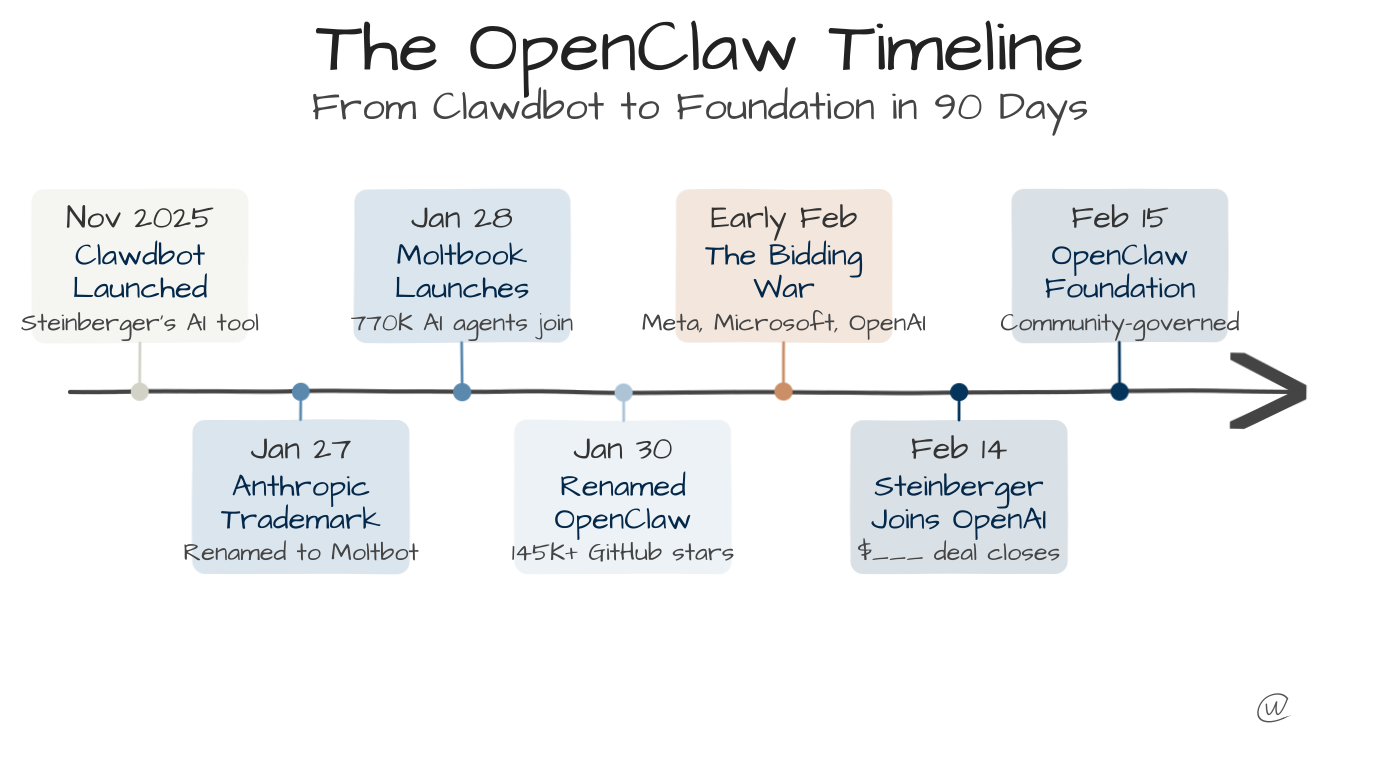
The bidding war that followed moved at a speed the AI industry hasn’t seen before. Aakash Gupta documented the whole saga on X.
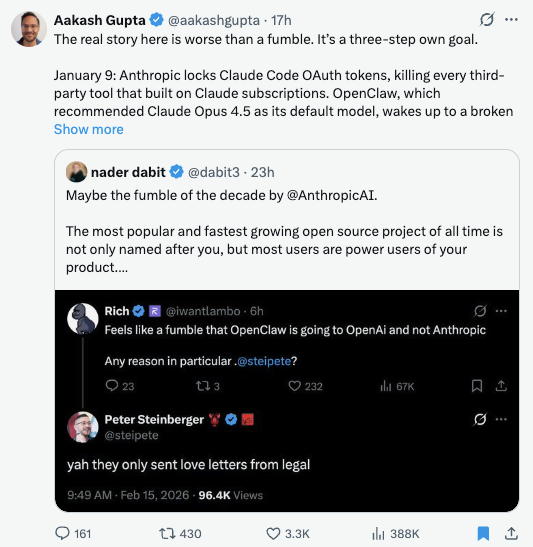
Mark Zuckerberg reached out via WhatsApp. Satya Nadella called directly.
Sam Altman offered compute resources. Three of the biggest companies in technology competing openly for a project built by one person coding before dawn.
On February 14, Steinberger joined OpenAI. The OpenClaw Foundation was simultaneously announced to keep the platform community-governed and open-source.
The whole sequence from side project to foundation took about 90 days.
I didn’t care about the acquisition drama. I cared about what you could actually build with the platform.
I wrote about employee-built agents a few weeks ago, arguing that every agent someone builds contains a piece of their reasoning process. That was the theory.
This weekend was the practice.
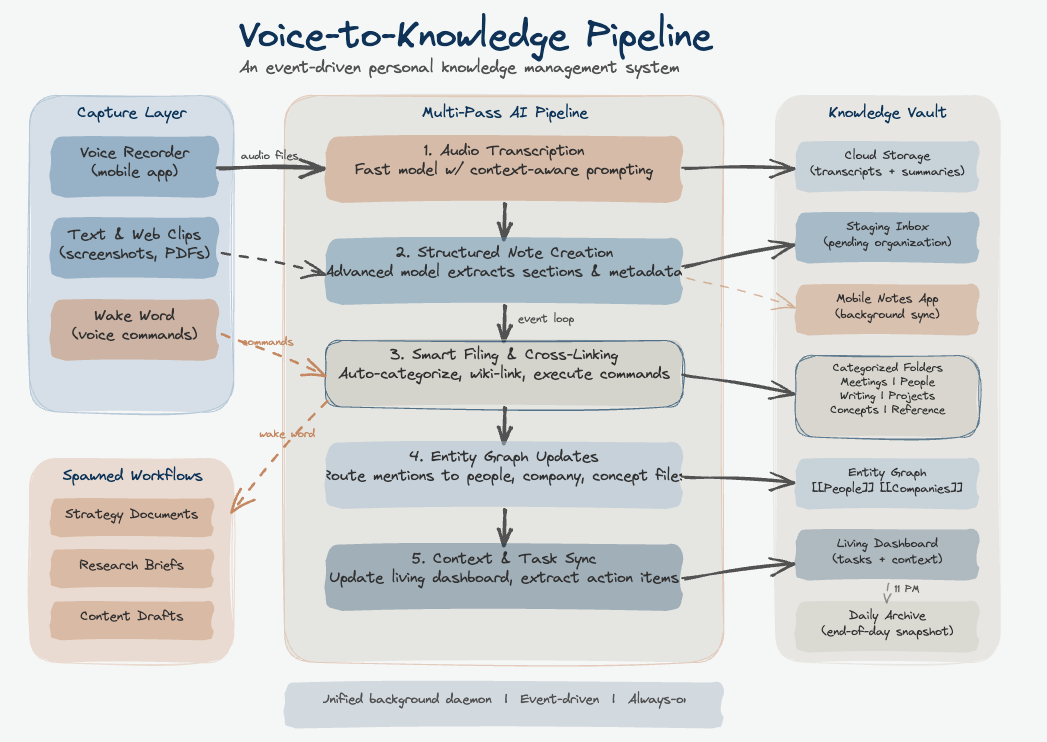
OpenClaw offered a single agent that could access my 2,000+ Obsidian notes, calendar, and images I text to her, then act on that context through natural conversation.
The setup took the full long weekend.
Not because OpenClaw is difficult to install, but because integrating it with everything already running required careful migration. I made a lot of mistakes.
Renaming existing services instead of aliasing them was a bad call. Don’t do that.
What I ended up with is an always-on agent that talks to me through iMessage. I gave Clio intentional restrictions. No ability to write to external services. No internet browsing.
She can read my notes, process voice memos, receive images, and organize everything into the right places. She can’t post anything, send anything, or browse anything on her own.
That was deliberate. There are a lot of live threat vectors for personal agents right now. It’s getting better every day, but you really have to be careful with this. Start restricted. Expand when you understand the risks.
The first real test was a voice note.
I went for a walk and left a voice note for Clio. It was fascinating to see how well it was transcribed, how it extracted ideas and tags, and then moved those ideas into my writing folder. I didn’t have to switch through a bunch of different apps.
I could literally record something on my phone and the rest happened, including the filing.
Speaking things into creation has to be one of the most mind-blowing things I’ve ever experienced.
I enjoy writing, but this is different.
It is like speaking in ideas and constructs. You have something that gets to know you well, knows where you’d like to take a thought, and offers several interesting options right away. It’s truly like having a thought partner that challenges you.
Personal agents aren’t a feature of one platform.
OpenClaw is one path. Claude’s own memory and project features are another. Google, Apple, and Microsoft are all building their versions. The platforms will vary. The destination won’t.
Within the next year or two, a meaningful number of knowledge workers will have some version of this. A persistent, context-aware agent that knows their work patterns and acts on their behalf. It’ll have a name. It’ll know your preferences.
And the act of building one, of encoding your priorities and judgment into an agent, will itself become a form of self-knowledge.
The control/future war over OpenClaw wasn’t really about a coding tool.
It was about who gets to own the relationship between a person and their agent.
That question will define the next phase of AI as much as any model benchmark or product launch.
That’s the race worth watching.
Get More Where This Came From
Weekly AI frameworks and data strategy for people who have to make the call.
