From the Newsletter
I don't want to be a user anymore
Software is going away, and that is the best thing that could happen to the companies smart enough to see it.

In the version of Tron my son and I love, "user" is an insult.
The programs living on the grid say it the way you would say outsider. Someone who does not belong here, who builds nothing, who just takes what the system hands them.
I have started to agree with the programs.
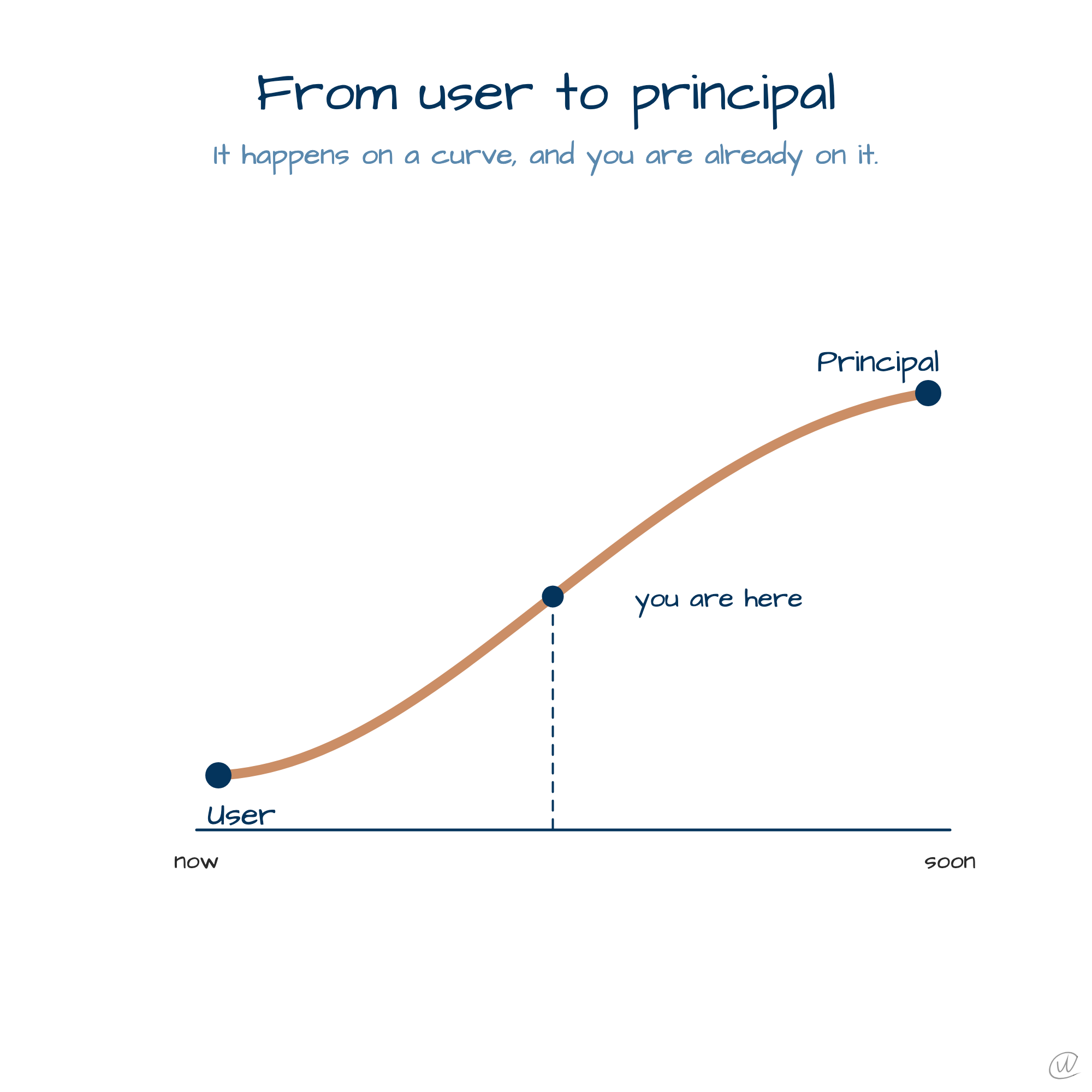
For most of my working life the deal was simple. A software company decided how the work should go, shipped you a fixed set of screens, and you bent your job to fit them.
You were a user.
You used what some UI team built, and that team did not know your business, your workflow, or what you were actually trying to do.
It is a pain in the ass. It is also constricting in a way we all just learned to swallow, because the software only ever did what someone else decided, at the pace they decided to ship it.
I do not want to live inside that bargain anymore. I do not think I will have to for much longer.
Software is dying fast, and I think that is great.
It is dying as a fixed product. What replaces it is software that is effectively infinite, because it gets shaped in real time by the person using it. Not one team's frozen idea of the workflow. The workflow you actually run, adjusted as you go.
The cage turns into clay.
This is suddenly possible because the cost of making your own software fell through the floor. You describe what you want done, and the system builds the path to do it.
The app stops being the room you live in. It becomes raw material you bend.
When you can shape the work instead of clicking through it, "user" stops fitting.
You are the one directing it now.
The cleaner word is principal. It comes from an old idea in economics, the principal-agent relationship, where an agent acts on your behalf while you stay the one in charge. That is what running these systems already feels like. You set the intent, the agents do the work, and you keep the judgment about whether they did it right.
Run more than one and something new shows up. You start to feel responsible for what they do, the way a principal carries a duty for the people acting in their name.
Not button-pressing. A set of workers you point at the world.
That is a strange and serious thing to hand a person, and it is arriving fast.
Two things landed in the same week and made this feel real instead of theoretical.
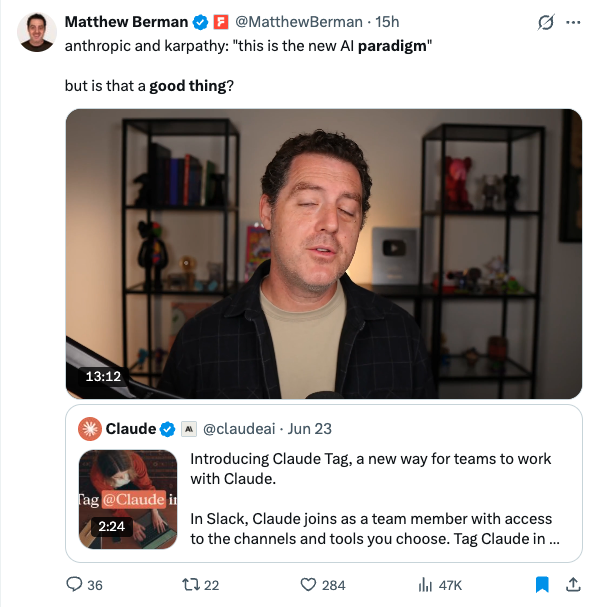
The first is Claude Tag. Anthropic dropped Claude into Slack as a teammate you tag into a channel and hand work to, then walk away while it runs. People are already arguing about whether that is a good thing.
The second is loop engineering.
A senior Anthropic engineer wrote it up plainly. You stop prompting the agent by hand and build the system that prompts it instead. Schedule, discover, build, verify, repeat. And the number underneath it is the part that stuck with me. Nine out of ten builders have never written a single loop that prompts their agent for them.
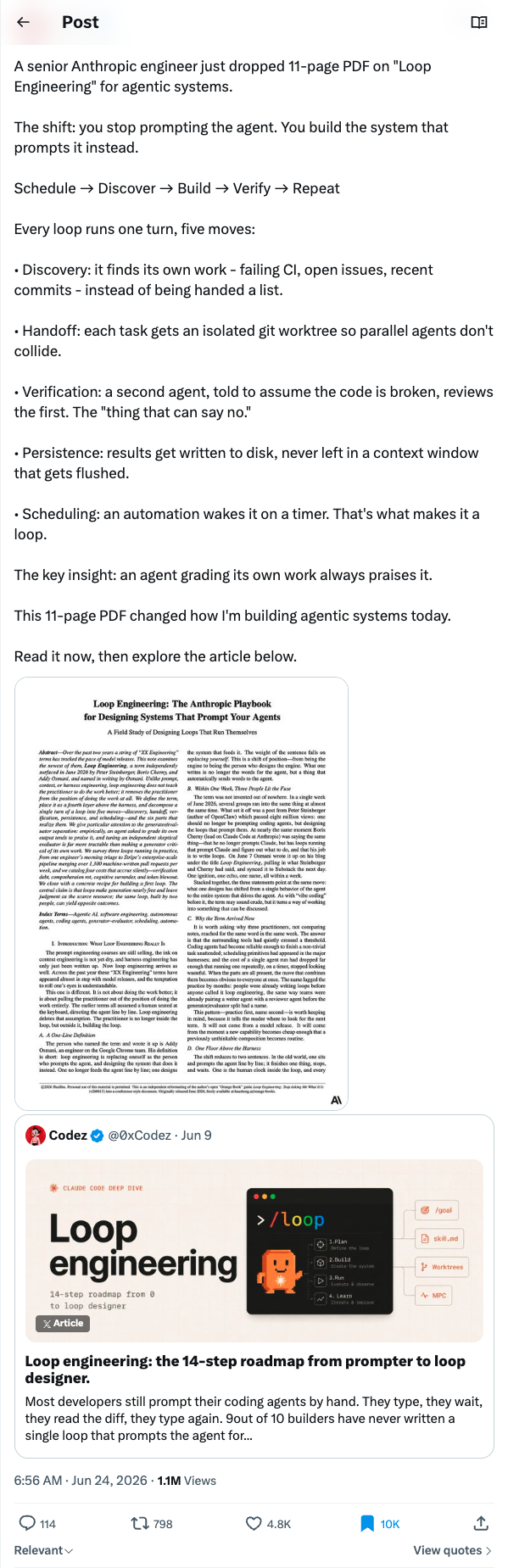
Claude Tag in Slack is that loop, running in public. A principal hands work to an agent and trusts the loop to carry it.
Put the two together and you can see what is coming for a lot of software companies.
If the app is no longer the moat, what is?
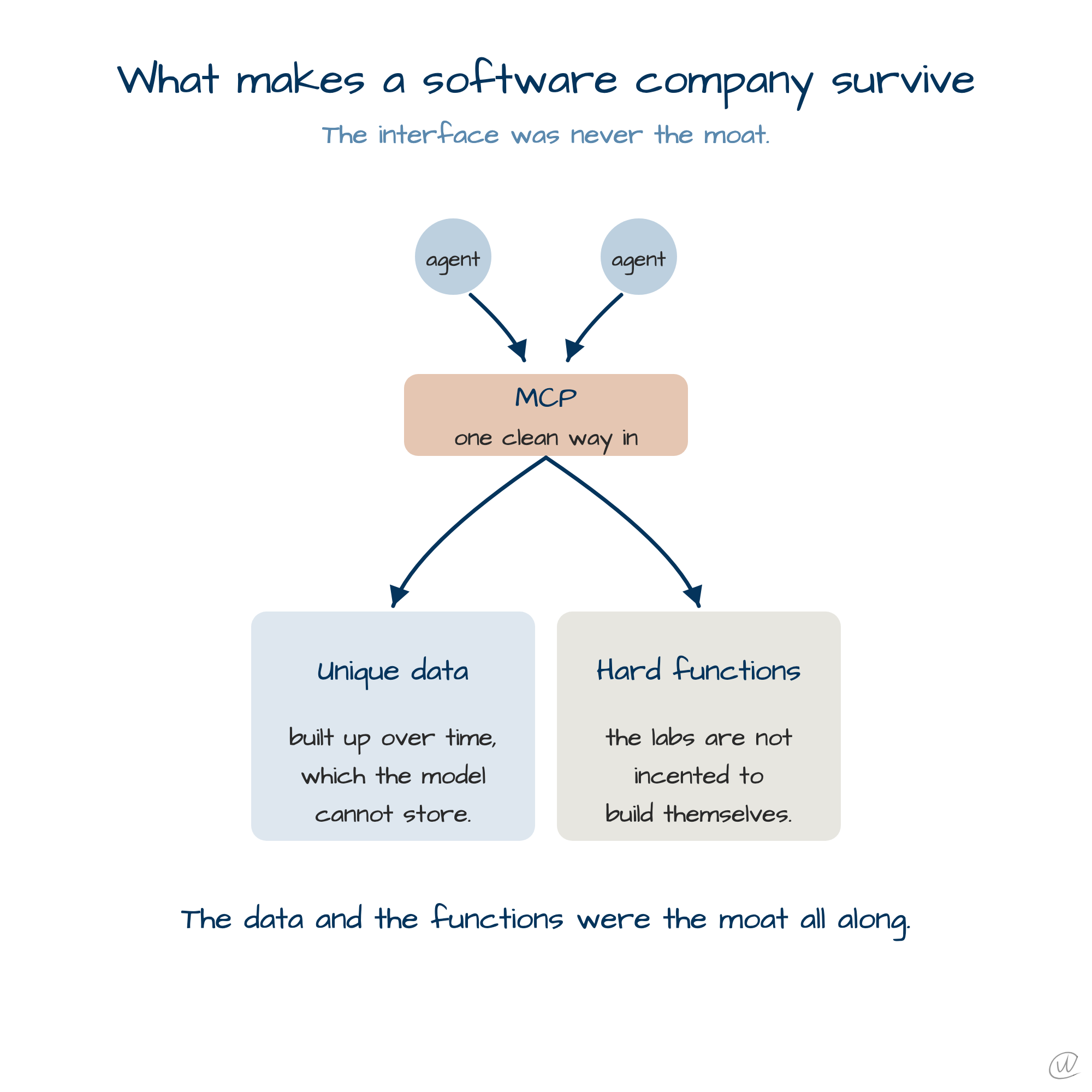
The companies that come out ahead turn everything they do into an MCP, a clean way for your agents to reach their capability with no screen in the middle.
Then they win on the two things the model does not have.
One is data built up over time, the record of what actually happened that no model stores or can reconstruct. The other is the hard functions, the capabilities that take real work to build, or that the labs have no reason to go build themselves.
That is the whole game now.
The interface was never the asset, a point I made a while back. The data and the functions were. Expose them well, and the agents everyone is now running will reach for you all day.
This reads like a funeral for software. For the right companies it is closer to the opposite.
If you have ever leaned on a tool that holds something you need but never moves at the speed of your work, you already know the frustration this fixes. The rigid front end falls away. The valuable part underneath, the data and the capability, finally gets to meet you where you actually work.
That is a genuinely awesome opportunity.
Software does not die. It just stops pretending the menu was the point.
And I get to stop being a user.
Get More Where This Came From
Weekly AI frameworks and data strategy for people who have to make the call.