From the Newsletter
Optimism Needs Memory
AI will not make companies faster if the company cannot remember what actually happened.

Companies want AI speed. But speed breaks when the company cannot remember what actually happened.
Peter Diamandis put up the cleanest version of optimism I have seen in a while.
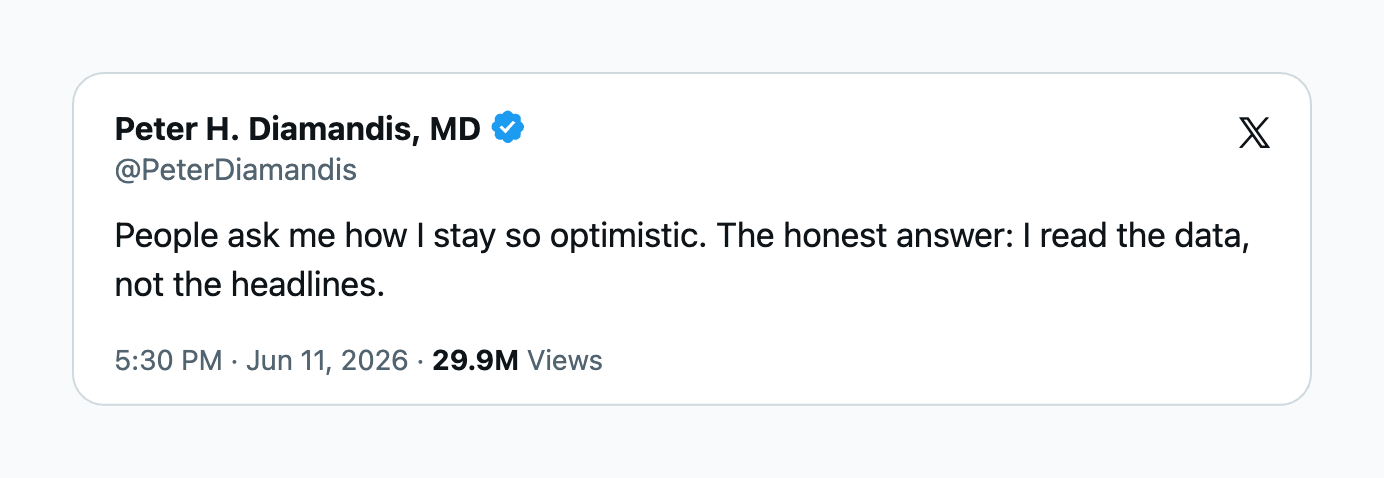
The line works because it makes optimism a discipline instead of a personality. The headline is loud, recent, and incomplete. The data is slower, but it gives you the one thing the headline cannot.
Direction.
Earlier this week I sat down with one of the large model providers, and the thing I was most thankful for was how clearly they understood where this goes. Once AI has real access through data connectors into email, Slack, and the other channels where a company actually communicates, it opens up an enormous opportunity for the companies that recognize it.
You start to get a massive diff. By diff I mean the differential between what was happening before and after. Think of it as time-lapse photography of everything happening in the company at any given moment.
Businesses are changing faster than they can track. Being able to go backwards in time and understand how you got to a particular point is what makes that speed survivable. In a single meeting you can feel the agenda move left, right, up, and down, and it is hard to say afterward how you actually got there. Capturing it preserves the different perspectives that were in the room.
Now scale that across a whole organization and watch the trends and directional changes everywhere at once. That is the real opportunity, but it only works if it is remembered, and only if it is accessible.
Most companies do not have a data problem. They have a memory problem.
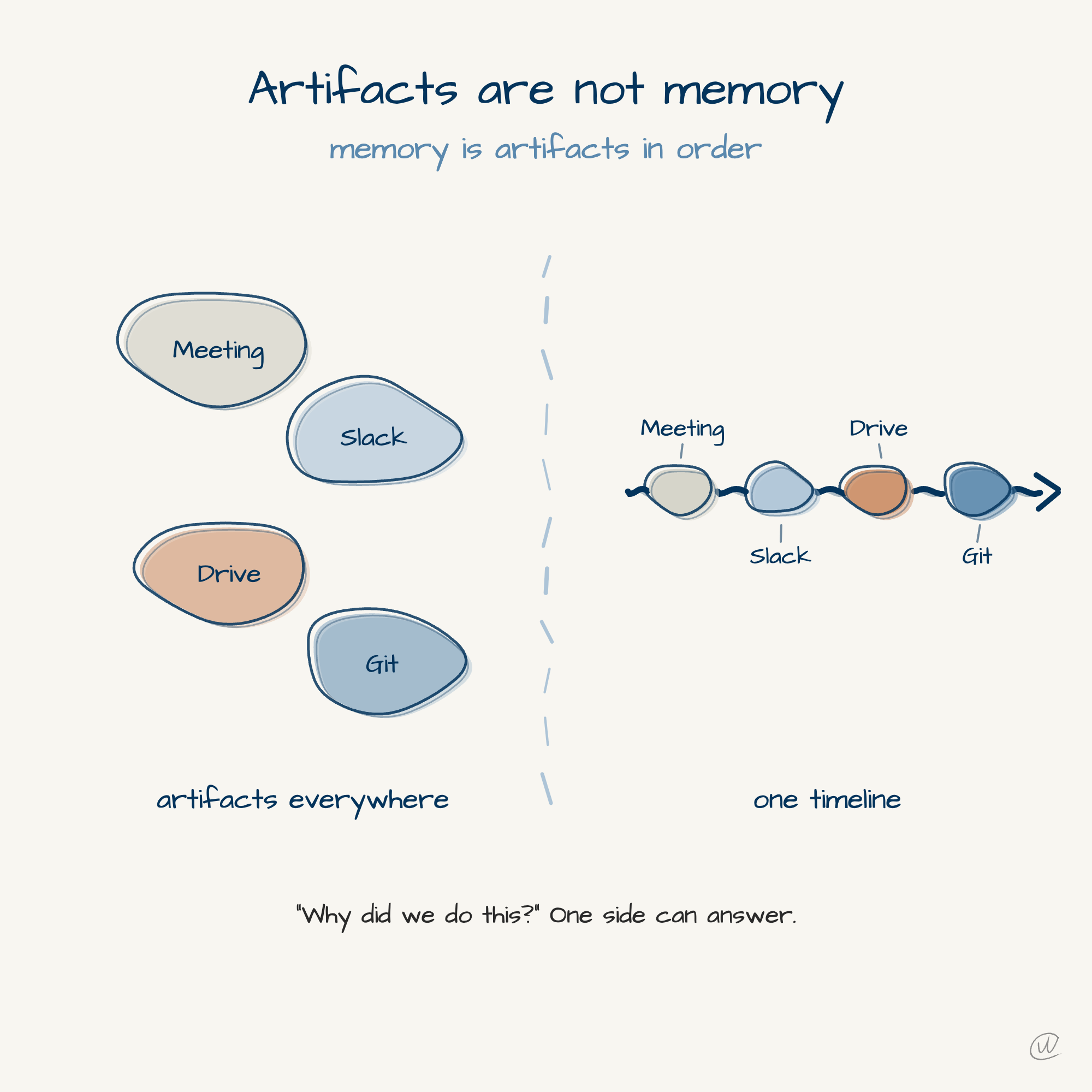
A decision happened in a meeting. The rationale is in someone's head, the follow-up is in Slack, the file is in Drive, the rollback is in Git, and the lesson is in the person who left six months later. Then an executive asks a reasonable question.
Why did we do this?
Everyone starts searching. The company has plenty of information. The information has no timeline.
John Suh thinks this is a rebuild-from-the-ground-up problem.
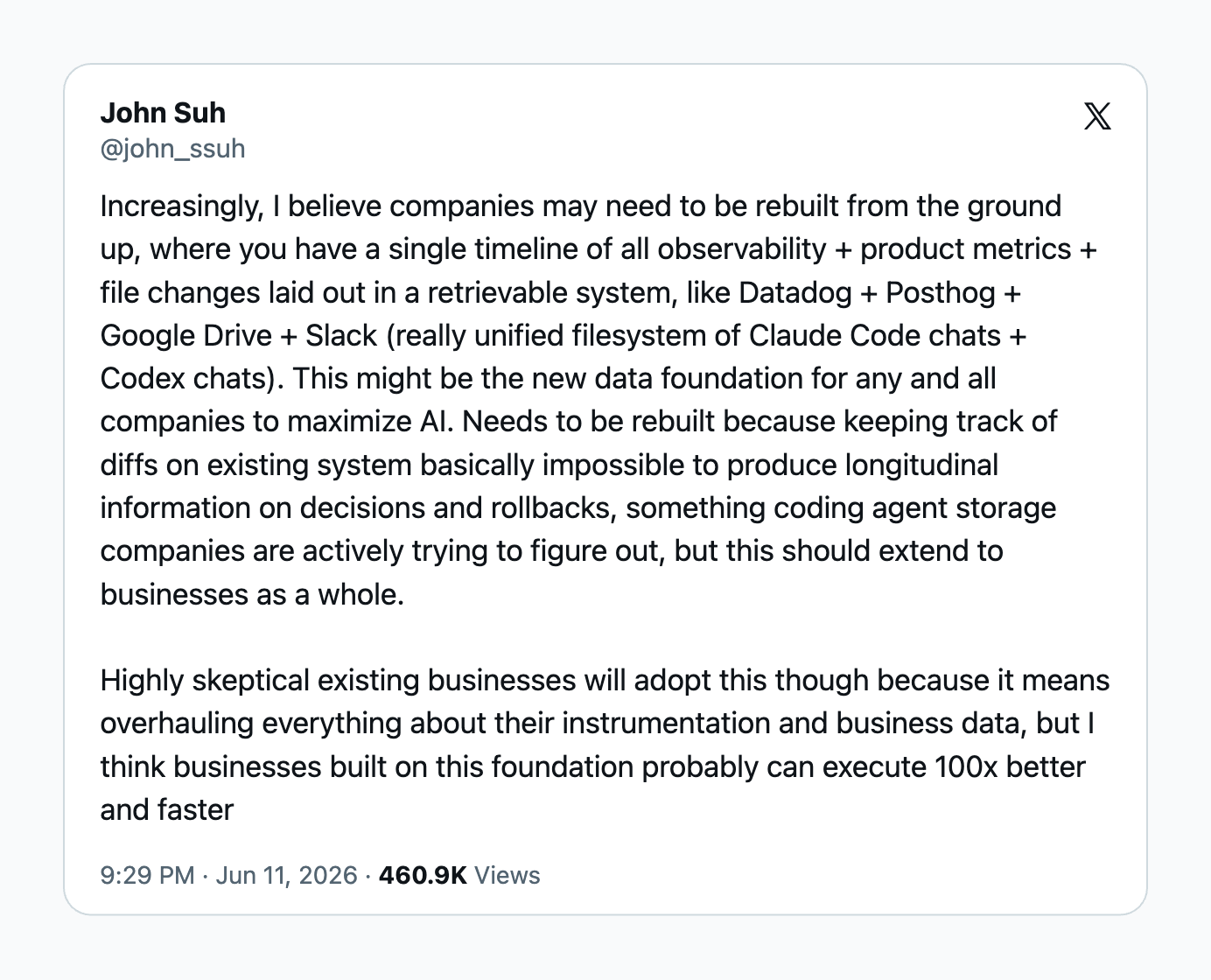
His point was bigger than another dashboard. A dashboard shows the state of something. Memory explains how it got there, and the explanation is where the judgment lives.
If a company cannot reconstruct the chain from signal to decision to action to outcome, AI becomes a fast layer on top of fragmented memory. Faster search is not understanding.
For a long time the data function was asked to report on the business, then to predict it. Now it has to help the business remember itself. Yesterday the unit of value was the trusted metric. Now it is the trusted history.
My bet is that the next serious layer of AI adoption is not a prompt library. It is a memory layer, a shared timeline where humans and agents see the same evidence, decisions, and outcomes.
That is what makes optimism honest. You are not optimistic because the headline feels good. You are optimistic because the evidence is visible and the organization can remember how it got here.
AI will reward companies that can act.
It will compound for companies that can remember.
Get More Where This Came From
Weekly AI frameworks and data strategy for people who have to make the call.