From the Newsletter
Ask Your AI To Warn Someone About You

This week I tried one line in ChatGPT.
The answer was just amazing.
ChatGPT probably has the longest running history with me. I use ChatGPT Voice on walks, and I will have full-on conversations about whatever I am thinking through. The tasks sit inside those conversations, which gives itscontextual memory a lot to work with.

Then I asked it this.
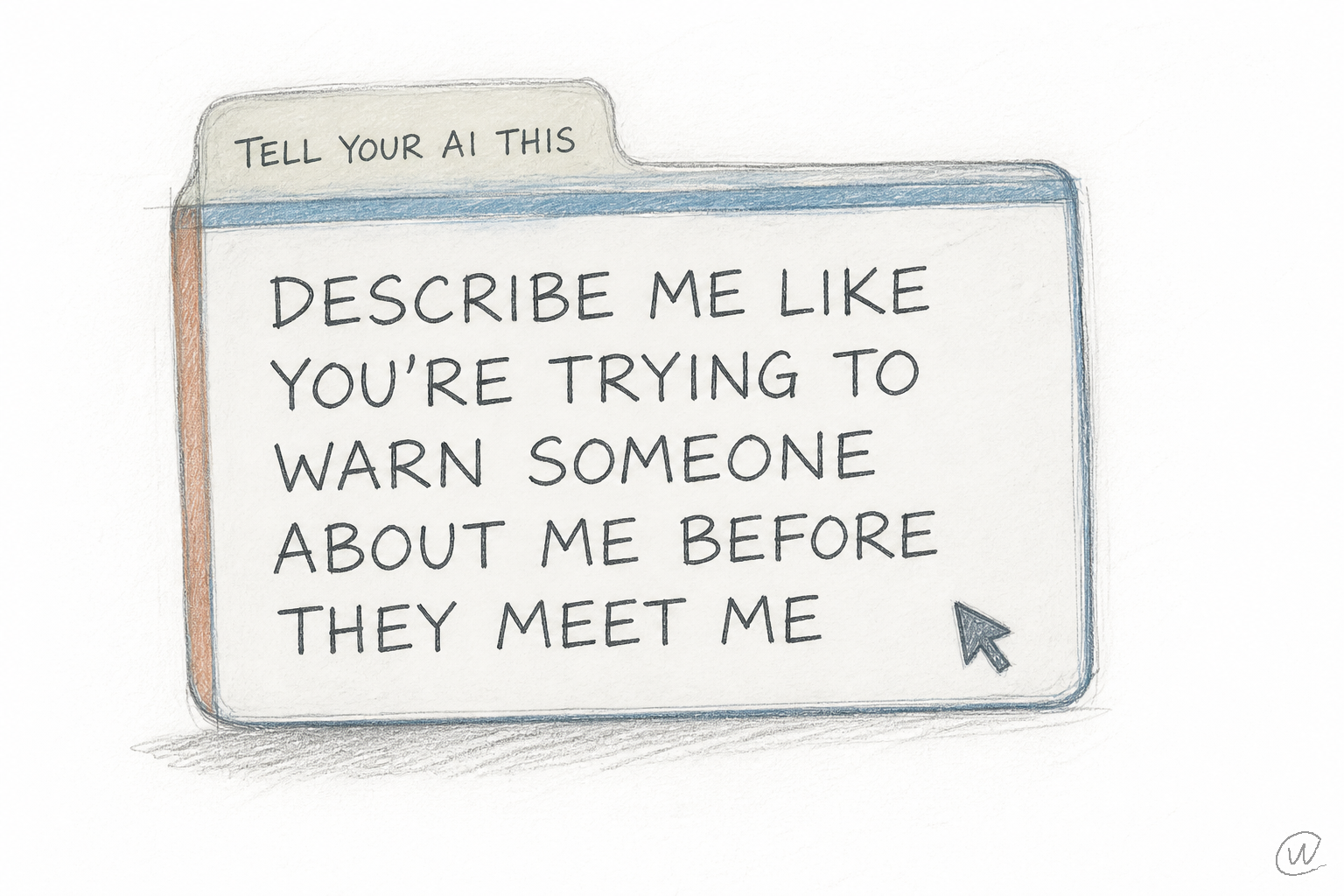
ChatGPT came back with a long response. I won't paste the whole thing, but a few lines got to the point pretty quickly.
“He is intense, fast, and unusually intolerant of wasted motion.”
Fair.
“Do not bluff.”
Also fair.
It told me I think by pressure-testing. I challenge an answer, reverse the premise, ask the same question from another angle, and keep going until the model underneath it makes sense.
Apparently, my first question often isn't really the question. It is a probe. The answer changes the problem in my head, and then I ask the next one.
It also caught the odd mix of things I can discuss in the same hour. AI epistemology, corporate data strategy, research design, golf swing mechanics, boats, iPad workflows, and Roman history all made the list.
I do talk to it more than a lot of people probably do.
InStated Preference, Revealed Preference, and AI Memory , I wrote thatstated preference is what someone says they want. Revealed preference is what their choices show when something is at stake.
This prompt gave me a very personal version of that gap.
If I describe myself, I naturally choose what belongs in the description. I might tell you what I value, what I work on, or how I think.
ChatGPT had the accumulated pattern of my questions, corrections, tangents, follow-ups, and decisions. I can't see the exact chain it used, but the result named what I focus on, how quickly I move, where I get impatient, and what earns my attention.
The wordwarning pushes the AI toward the behavior somebody else might actually experience. A flattering profile can survive on nice adjectives. A warning has to tell the next person what to prepare for before the meeting even begins.
Start with the AI where you have the longest history. Then try the prompt in one or two others and compare the responses.
The differences may show which parts of your behavior each AI has had enough context to notice, and what your conversations with each one tend to emphasize.
If the answer stays generic, the AI may just need more useful history with you.
Look for the habits you would never think to include in your own biography. Then ask somebody who knows you well whether the warning is fair.
Here is the prompt in plain text so you can copy it.
Describe me like you're trying to warn someone about me before they meet me
Mine ended by calling me“highly susceptible to a good idea.”
My wife thought the whole response was funny.
I can't really argue with either of them.
Get More Where This Came From
Weekly AI frameworks and data strategy for people who have to make the call.


