From the Newsletter
4 Features That Untethered Me from My Desk
How Claude's Shipping Speed Rewrites Where Work Happens

I am writing this blog post while walking through my small town in Florida, speaking it into my phone.
The AI agent on the other end is simultaneously managing my Obsidian knowledge graph, syncing my calendar, processing voice notes from yesterday's architect meeting, and keeping my task list prioritized across eight active projects.
I haven't been at my desk for over an hour.
The work hasn't slowed down.
Four things shipped in the past eleven days that made this possible, and I think they're worth explaining.
Anthropic shipped four things in the span of eleven days that, taken together, changed how I work.
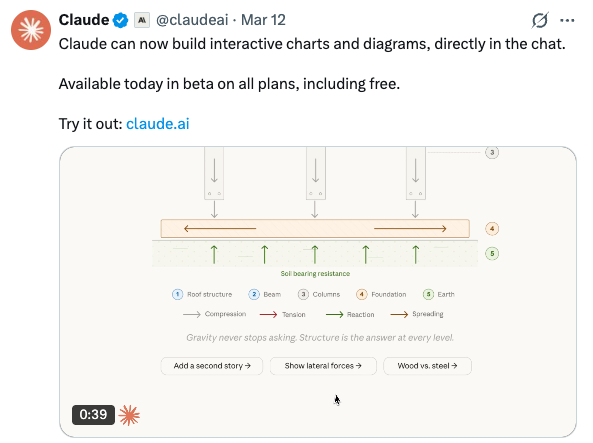
On March 12, Claude launched inline interactive visualizations.
Charts, diagrams, flowcharts, and data widgets now render directly in the conversation as interactive HTML, responding to clicks, toggles, and hover states. Gemini and ChatGPT had been ahead on this for months, but Claude's implementation caught up fast.
It feels native to the conversation rather than bolted on, which matters more than most people realize when you're building real-time analysis. The speed of development across all three platforms is staggering, but Anthropic's cadence over the past two weeks is incredible (and kinda killing me.)
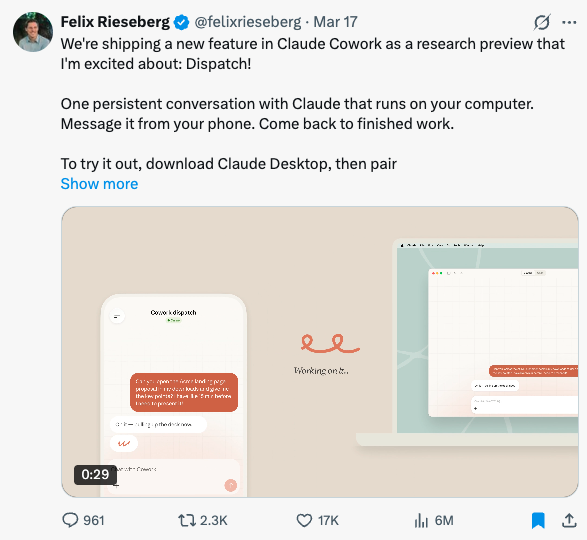
On March 17, Felix Rieseberg, who leads Cowork and Claude Code Desktop at Anthropic, announced Dispatch. "One persistent conversation with Claude that runs on your computer. Message it from your phone. Come back to finished work."
That tweet got 6 million views fast.
People understood what it meant immediately. We all thought Anthropic might ship a better OpenClaw than OpenClaw, and they did.
On March 20, Channels arrived, bridging Claude Code sessions to Discord and Telegram.
Messaging apps become command interfaces for an AI agent running on your machine. Your files never leave your computer, and the agent keeps working whether you're watching or not.
Ethan Mollick tried Dispatch and said it "covers 90% of what I was trying to use OpenClaw for, but feels far less likely to upload my entire drive to a malware site."
The vast majority of what I had been using OpenClaw is now more secure, more stable, and better integrated through Claude's own products.
OpenClaw was brilliant for proving the concept. Anthropic productized it in just a few weeks.
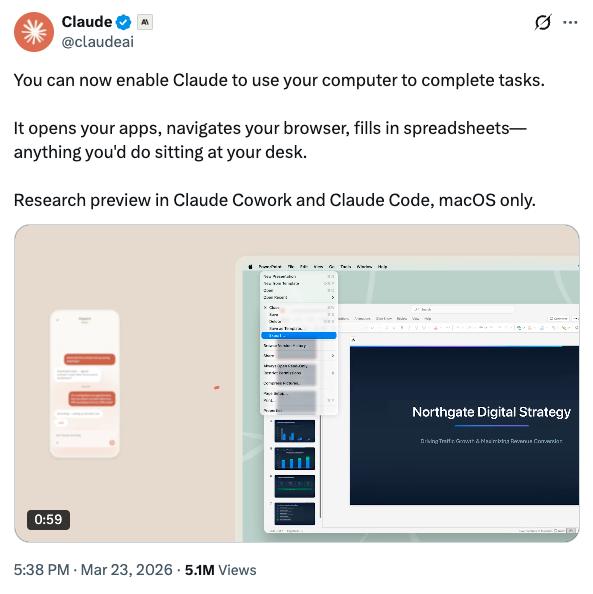
Then, on March 23 (today, as I'm writing this), Claude announced Computer Use in Cowork and Claude Code. "It opens your apps, navigates your browser, fills in spreadsheets, anything you'd be sitting at your desk."
This is the link in the chain I've been (probably) waiting for the longest. I wrote about this last year several times including in Conversational Interfaces Break Jakob's Law.
You can now tell it to move between files and locations, open different applications, and walk it through what you need done. Then iterate on that from anywhere.
I originally bought a Mac Mini to explore OpenClaw and learned a ton in the process.
It doesn't make sense to run OpenClaw now when Claude can do all of it on its own.
But the Mac Mini itself? That dedicated, always-on computer has become the single best investment I've made in my productivity stack.
It runs my voice pipeline, my knowledge graph, my task system, and now, with Computer Use, it can operate any application on my behalf while I'm somewhere else
Here's how I think about this.
You're at your kid's baseball game on a Saturday afternoon. You give Claude a task, then watch an at-bat. A half-inning later, you check in.
The work is done, or it has a question for you.
You answer it and go back to the game.
I understand the objection. Be present, unplug, watch your kid play...
I hear that, and I don't disagree.
But having an agent working on your behalf at a detailed level is no different from being on vacation with several employees you trust to get things done while you check in from time to time.
The difference is that this employee costs $20 (or $200) a month and doesn't need sleep.
The more we embrace these workflows and rethink them completely, the better we're going to do.
The gap between teams that redesign their workflows for AI agents and those that bolt AI onto existing processes will widen every quarter.
We figured out a year ago that AI can do tasks faster. The more interesting realization is that the container of work is changing.
The desk, the office, and the laptop open on a table were requirements for the tools, not for the work.
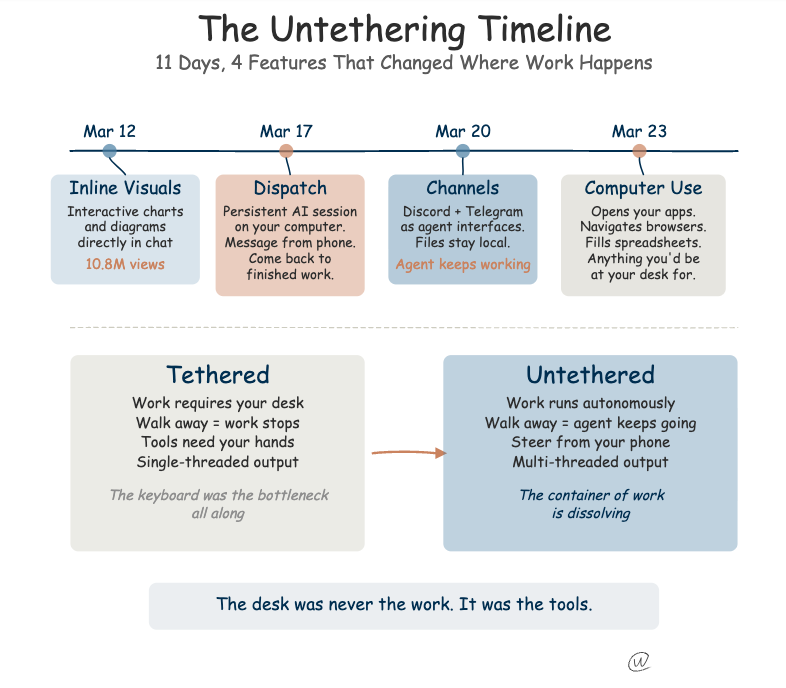
When those tools run autonomously on a machine at home and communicate through the same messaging apps you use for everything else, the container dissolves. What remains is your judgment, your decisions, your creative direction, and the ability to check in from anywhere.
I don't think things are going to slow down ever again.
But if I can plan my workweek knowing I have a team of agents I can reach and delegate to at any time, it frees up a ton of thinking time.
As well as time to watch Little League.
Get More Where This Came From
Weekly AI frameworks and data strategy for people who have to make the call.

