From the Newsletter
Economics When AI Shows Up
Six Famous Theories, and What AI Does to Each One

I am fascinated by economics. Always have been.
Not the equations... the relationships. Who knows what, who does the work, how fast things can change hands.
Lately my X bookmarks are full of people describing what AI is doing to their work. A designer says he is done. A security researcher watches one prompt replace a thirteen-year employee.
They are all telling pieces of the same story, and economics wrote that story down decades ago.
So let me walk through six famous theories, the way I wish someone had walked me through them.
For each one, the idea in plain words. Then what AI does to it.
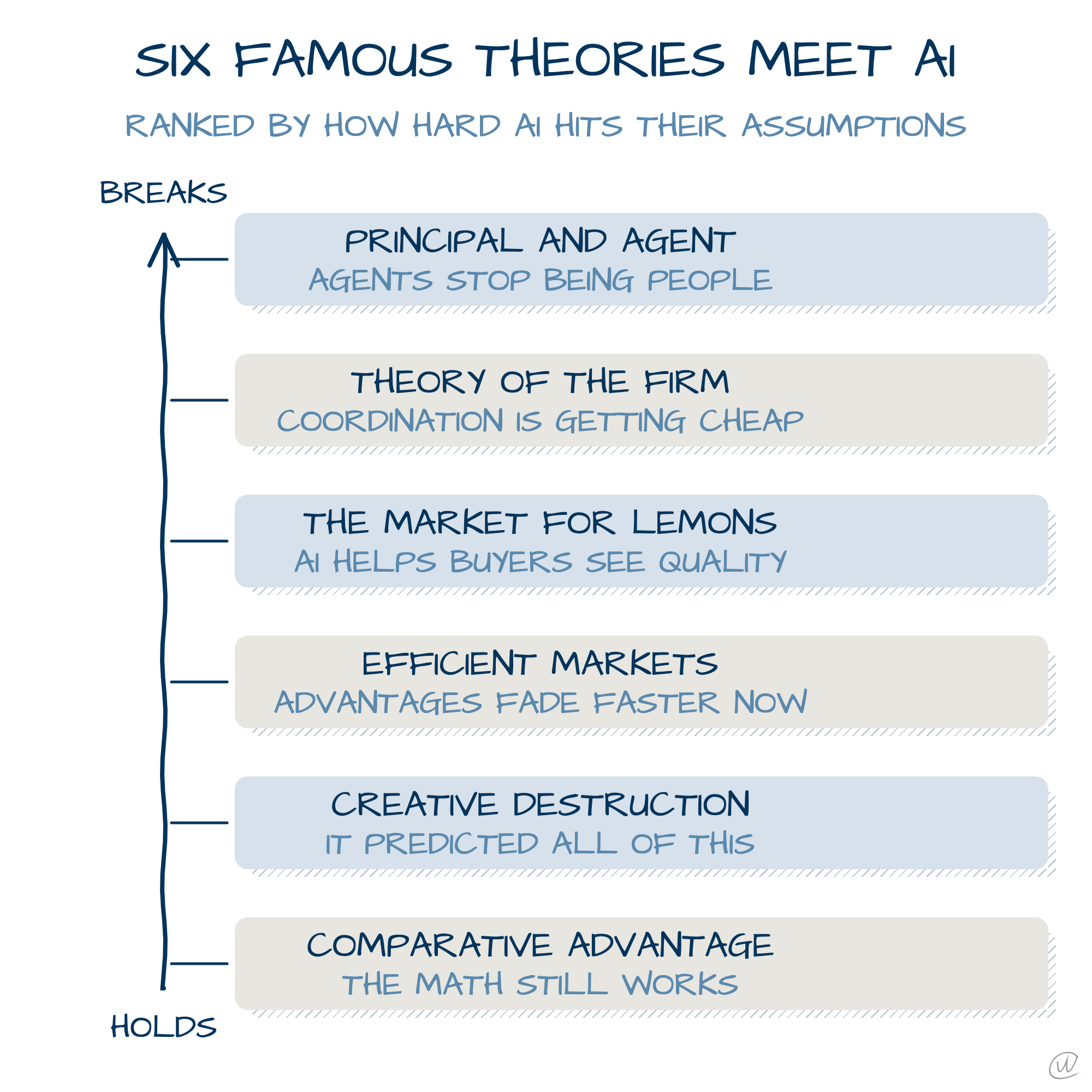
How I ranked them is simple. The more a theory depends on information staying expensive or coordination staying hard, the higher it sits, because those are the two things AI attacks. Comparative advantage sits at the bottom because it is arithmetic, and arithmetic does not care what tools we use.
Start in 1970. An economist named George Akerlof wrote a short paper about used cars, and it eventually won him a Nobel.
His question sounds almost silly. Why is it so hard to sell a good used car?
Picture the lot. Some of the cars are great. Some are lemons, cars with problems you cannot see. Kick the tires all you want, you still cannot tell which is which.
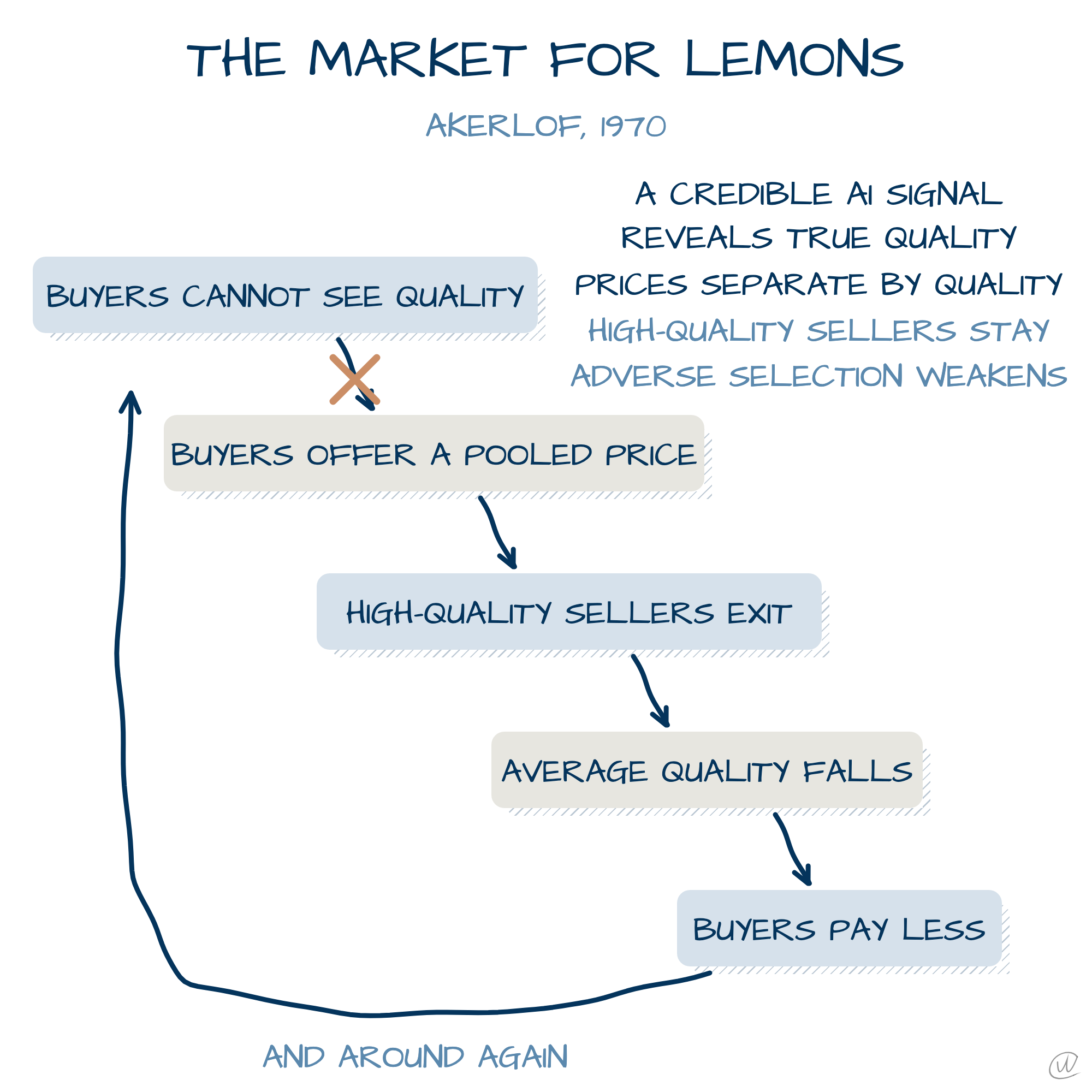
So what do you offer? Something in the middle. One averaged price for the whole mystery pile.
Now stand on the other side of the deal. You own one of the great cars, and that middle price is an insult.
So you keep your car and go home.
The best cars left the market first.
The cars still for sale got worse on average, so buyers offer even less next time, and the market spirals down. Economists call it adverse selection. It is the reason buying a used car feels like gambling.
Design works the same way from the client's chair. A client cannot see quality before paying for it. So clients price designers like the mystery pile, and the best designers drift toward the few clients who can tell the difference.
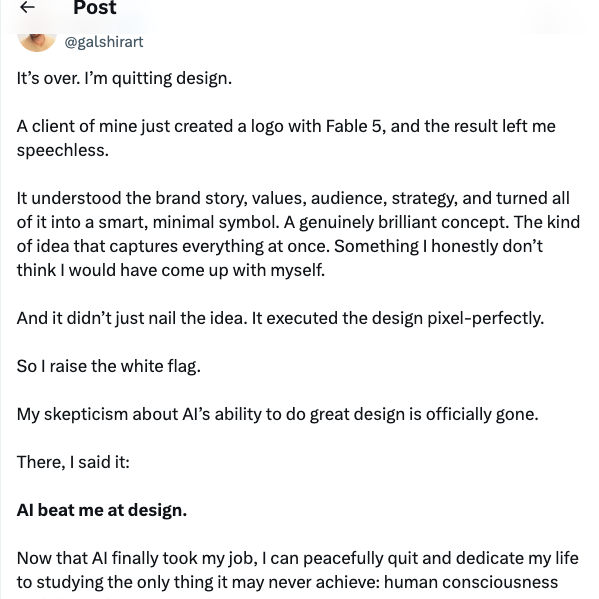
Gal Shir designs for a living, and he just watched Fable 5 make a logo that left him speechless. His words, AI beat me at design.
Now run Akerlof's story with AI in the room. If a model can score the work itself, and buyers trust the score, prices start matching quality again.
The good sellers get to stay. The spiral weakens.
The catch is that word, trust. Sellers can tune their work to please the scorer, and they can hide what the scorer misses.
AI weakens the lemons problem. Ending it is a bigger promise than the models can keep.
Jump to 1976. Two economists, Michael Jensen and William Meckling, put a name on something every company already felt. When an owner hires someone to act for her, the hire knows things she cannot see and wants things she does not want.
Maybe he pads his hours. Maybe he coasts. She cannot watch everything.
So companies buy insurance against their own people. Performance reviews. Middle managers. Stock options.
All of it exists to keep the agent pointed the same direction as the owner, and all of it costs money. Jensen and Meckling called that money agency cost.
The theory has one quiet assumption baked in.
Agents are people.
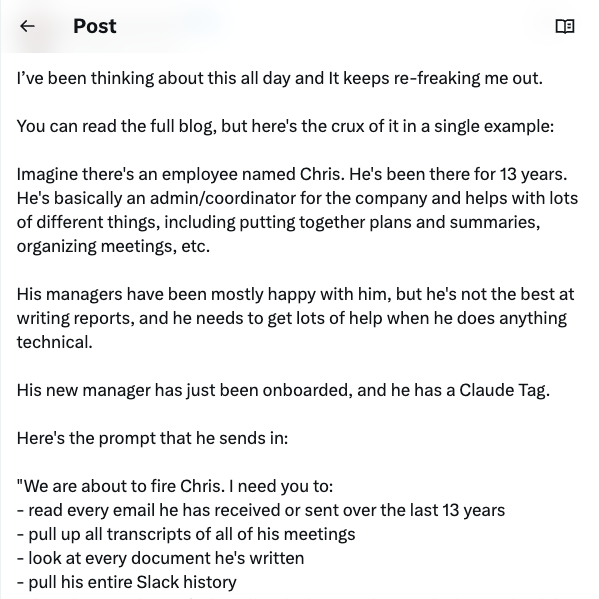
Daniel Miessler's story is what happens when that assumption fails. A new manager opens Slack and types one prompt about a thirteen-year admin named Chris. Read everything he ever produced. Figure out what he actually does. Schedule it to happen automatically.
Thirty-seven minutes later, the work is running on its own.
An AI agent has no hidden agenda, and checking its work costs nothing. The manager can read every step it took, in plain English, any time she wants.
Agency cost goes to zero, and the machinery built to manage it follows. I wrote about the other side of this move in I Don't Want to Be a User Anymore.
This one is older, 1937, and it starts with a question so basic most economists had skipped right past it.
Why do companies exist at all? Why does anyone take a salary instead of everyone selling their work task by task?
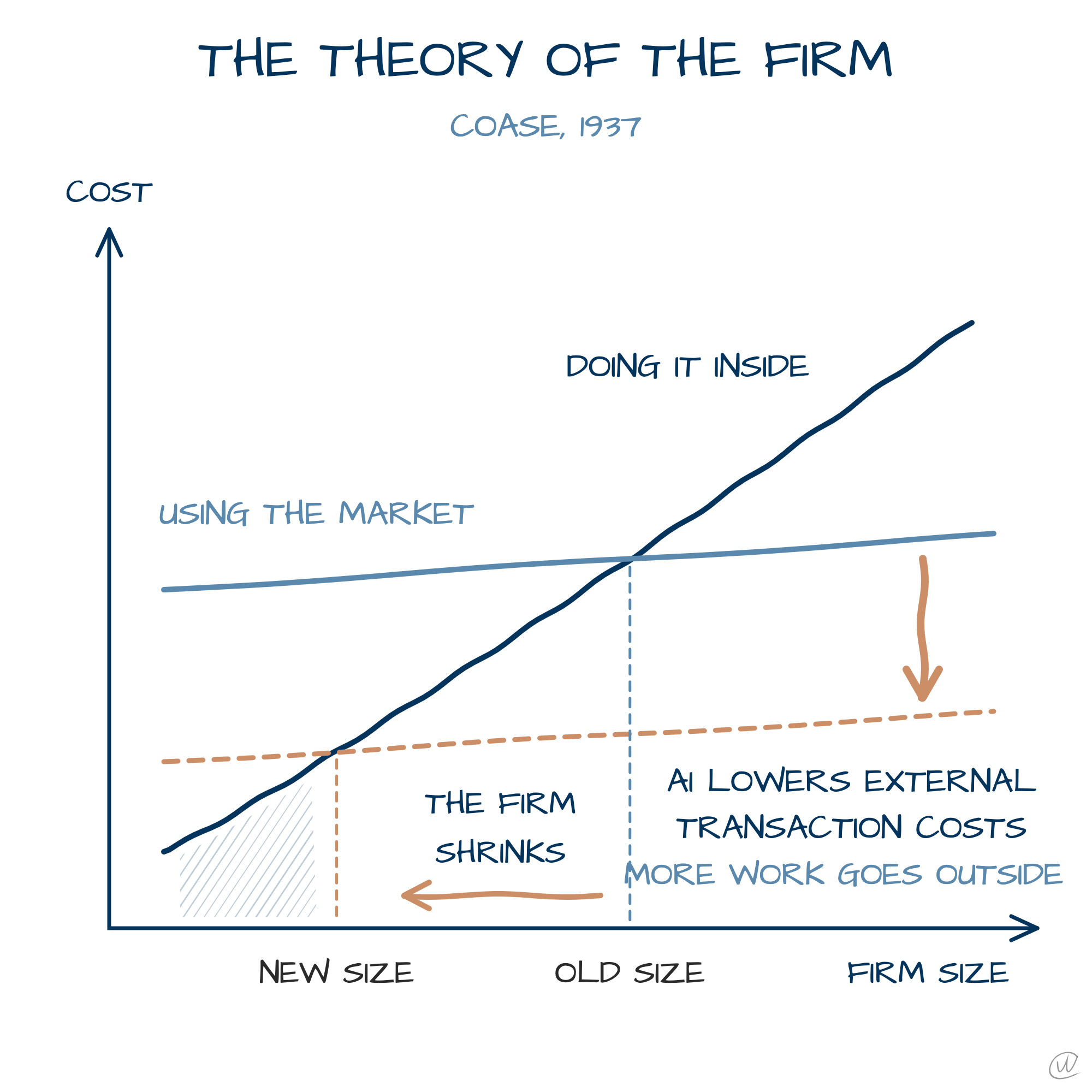
Ronald Coase's answer is that using the market is a hassle, and hassle costs money. You have to find the right person, agree on a price, check the work, and chase them down if it goes wrong.
Sometimes it is cheaper to skip all of that and just employ someone. So a job stays inside the company as long as that is the cheaper way to get it done, and the company stops growing right where those two costs cross.
Miessler's manager did not stop at one employee. The next question in his story is why not run this for the whole company.
That is a Coase question, whether he meant it or not.
AI makes it cheaper to find, hire, and check outside help. When the outside cost falls more than the inside cost, companies shrink, and work shifts from jobs to contracts.
But AI cuts the inside costs too. Cheaper supervision, cheaper handoffs, cheaper company memory.
If the inside cost falls faster, companies could actually get bigger. The theory does not pick a direction for us... it just says watch which cost is falling faster.
I do not know where the size of a company settles after this.
Smaller is a safe bet.
Back to 1970, this time with Eugene Fama. His idea is that a price soaks up information almost as fast as the information appears. If everyone knows a stock is a bargain, it stops being a bargain by lunchtime. Any edge you find gets copied and priced in, so nobody beats the market for long.
He was talking about stocks, but the idea fits any market where information moves freely. Expertise has been a slow market. Your hard-won tricks could feed a career for decades, because they spread slowly.
Jaya Gupta's post on value capture shows that speed changing. She wrote it in one line. "You contribute the unique and receive the average."
Feed your special workflow into a model and it stops being special. It becomes everyone's starting point.
Ten thousand hours of hard-won process, priced in like a stock tip... hours instead of decades. The market for what you know is starting to move at stock speed.
Joseph Schumpeter, 1942. He argued that capitalism grows by tearing down its own buildings. A new technology does not politely join the old economy... it wrecks the old companies, the old skills, and the old prices, then builds something new in the rubble.
Stop the wrecking and you stop the growth too.
My bookmarks this week are a catalog of his theory. A designer quitting. A VC mapping where the value goes. An admin job folded into a prompt.
I do not think much of what runs on knowing-more is defensible for long, from design all the way down to manual labor once robots are infused with AI.
Schumpeter would not be surprised by any of it.
He would just note the speed. AI is a strange entry in his story, because it speeds up the wrecking-and-rebuilding machine itself. His cycle does build as it wrecks, and the new jobs do arrive... eventually. If the wrecking runs far enough ahead of the building, the years in between hurt.
AI is about to test how long eventually takes.
The oldest one. David Ricardo, 1817.
Imagine one country is better at making everything. Portugal, in his example, made both wine and cloth cheaper than England could. You would guess England loses everything.
It does not.
Portugal only has so many hours. Every hour Portugal spends weaving cloth is an hour it cannot spend making wine. And wine is its most profitable product. So Portugal makes the wine, England makes the cloth, they trade, and both countries end up with more than they had working alone.
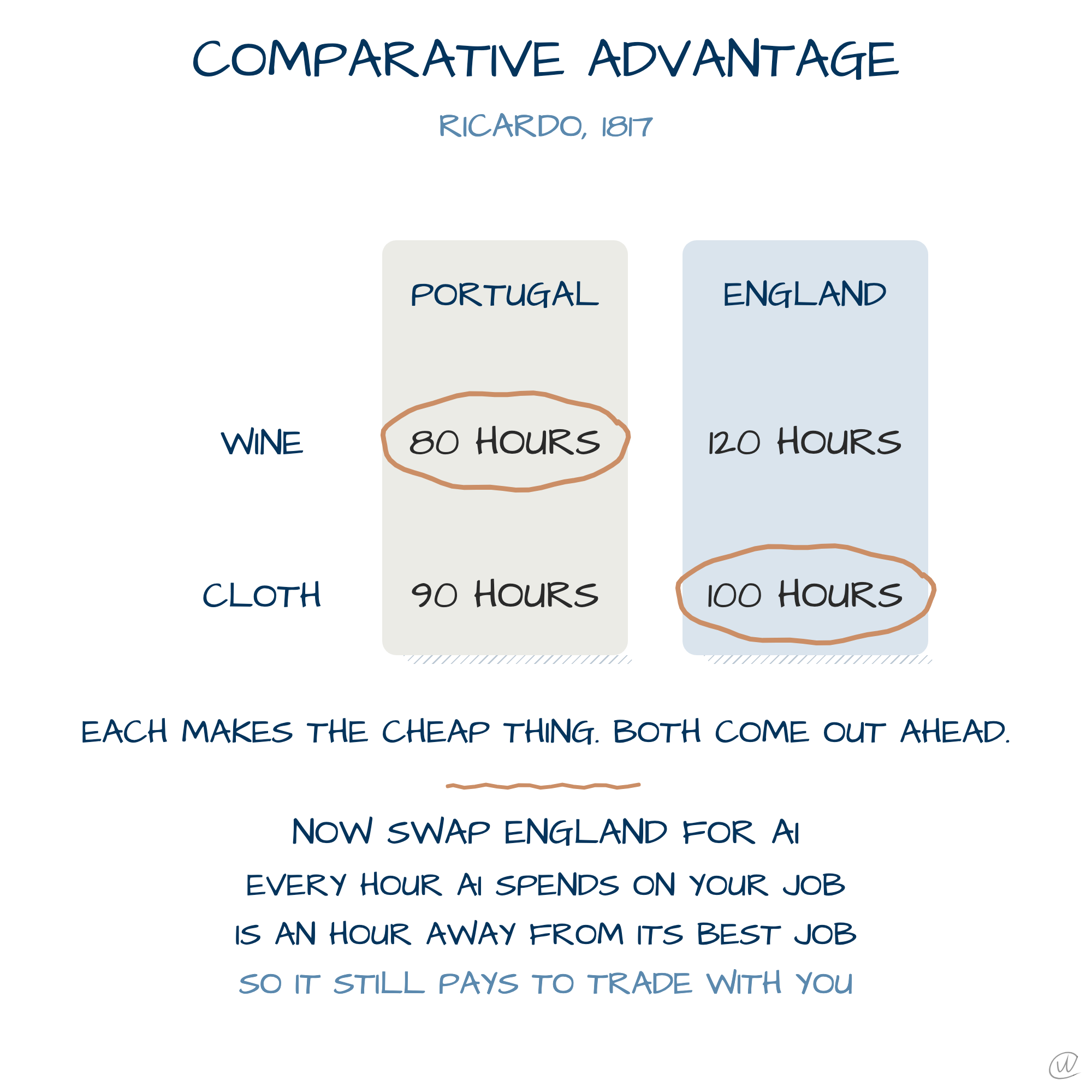
Now swap England for you, and Portugal for AI. Even an AI that is better than you at everything has the same limit Portugal had. Its hours spent on your work are hours it cannot spend on its best work.
So trading with you still pays, and the seat at the table survives. The theory just never promises what the seat pays. It also never promises the seats stay put... relative advantage used to shift over a generation, and AI can reshuffle it in a product cycle.
I expect AI to challenge every one of these theories, hard.
I do not know which way it breaks. It could mean far more people starting their own companies. It could mean companies get a lot smaller. Or the inside costs could fall so far that companies want more people, not fewer.
Engineering hiring is already doing the third one. People called AI the end of engineers, and demand for engineers has never been higher... especially for engineers who understand AI.
The internet was the biggest change of my lifetime. This is bigger, and it is going to interact with these theories in very, very strong ways.
Get More Where This Came From
Weekly AI frameworks and data strategy for people who have to make the call.


