From the Newsletter
SaaS Reincarnated
Data + AI Is the New SaaS. The Model Is Changing, Not Dying.

Data + AI Is the New SaaS. The Model Is Changing, Not Dying.
$285 billion wiped from software stocks in 48 hours.
Bloomberg called it the "SaaSpocalypse."
Within a week, the obituaries were everywhere. SaaS is dead. Software is dead. The UI is dead. Here's what actually happened, and why the loudest will continue to get it mostly wrong.
The Case Against SaaS
Satya Nadella, Microsoft's CEO, told an audience that SaaS applications will collapse in the agent era, and that the old model of renting software interfaces is ending. The market took him seriously. $285 billion in value disappeared in two days.
Zain Hoda built on Nadella's argument with a piece that went viral. His claim is that most enterprise SaaS products are surprisingly thin. The data inside them could fit on a thumb drive.
The APIs are wide open. And once an agent pulls a full copy, the original application has nothing left to offer except a login screen nobody visits (or wants to visit).
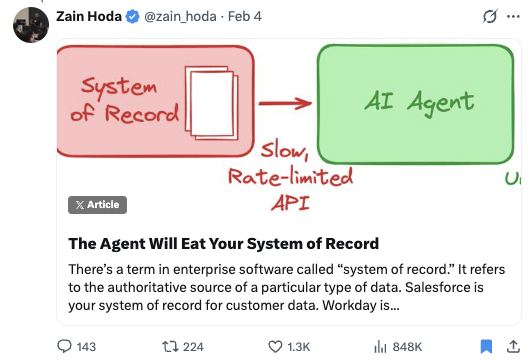
"What is your product if the data doesn't have to live with you? What's the value of your UI if no one's looking at it?" — Zain Hoda
Hoda's argument is specific and well-constructed.
For single-purpose SaaS that stores static, structured data behind a web interface, agents really can replicate the contents and build a better experience around them. CRM records, HR profiles, project boards. These are small, structured, and copyable in seconds.
I don't think this is a wrong perspective - but it assumes that data is often static, which is increasingly not the case.
Ask yourself these questions.
Do you think AI systems will want more data in the future, or less?
Do you think AI systems will want more real-time data in the future, or less?
Do you think AI systems will want more confidence in data accuracy, or less?
If you answered "more" to each question, I concur.
The Pushback
Allow me to introduce the alternative concept.
Jensen Huang, at the Cisco AI Summit, called the idea that AI would replace software "the most illogical thing in the world." His reasoning is simple.
AI agents use software tools. More agents mean more demand for data & infrastructure, not less.
Steven Sinofsky, former President of the Windows Division at Microsoft, pointed out that we've watched this same prediction fail three times in a row.
PCs were supposed to kill mainframes in the 1990s. Both grew.
E-commerce was supposed to kill retail in the 2000s. Amazon and Walmart both hit a trillion dollars.
Streaming was supposed to kill media in the 2010s. More media exists today than at any point in history.
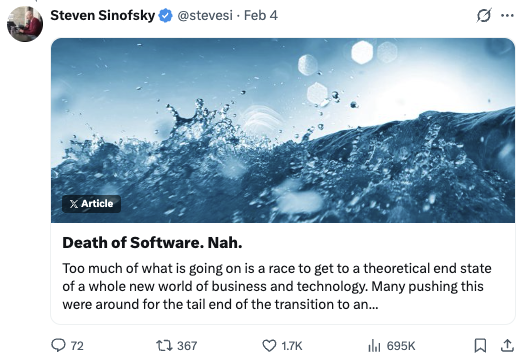
"AI changes what we build and who builds it, but not how much needs to be built."
— Steven Sinofsky
Garry Tan, CEO of Y Combinator, invoked Jevons Paradox to make the same point from the demand side. When a resource becomes dramatically cheaper to use, total consumption goes up, not down.
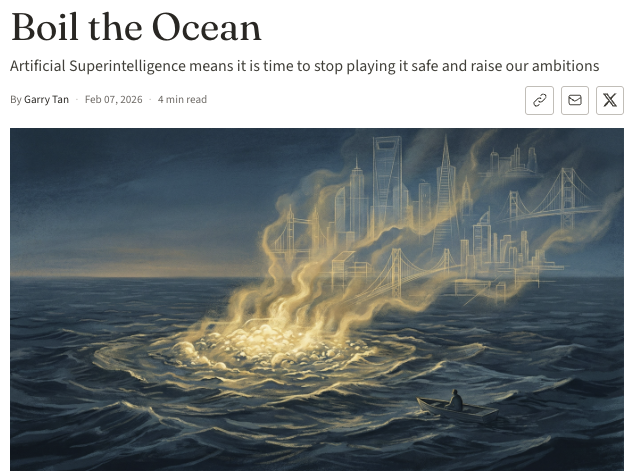
His example was steam engines. They didn't shrink the coal industry. They made coal so useful that demand grew by orders of magnitude.
His argument is that AI will do the same thing to software.
"Our fear of the future is directly proportional to how small our ambitions are. If your plan is to keep doing exactly what you're doing, then yes, a machine that can do it faster and cheaper is terrifying. But if your plan is to do something dramatically bigger, then the machine is the best news you've ever gotten." — Garry Tan
SaaS isn't dying. It's being reincarnated.
The part that's dying is the one-size-fits-all model, the version that forced every business into the same workflows and then required massive consulting practices from Accenture and Deloitte just to make it fit.
That formula is breaking. What's replacing it is simpler and more powerful. And for the past several weeks, I've seen this awakening with my own team.
Data + AI = the new SaaS.
When anyone can build their own interface on top of their own data, the value shifts from the application layer to the underlying infrastructure.
Paradoxically, that probably means more software gets built, not less.
But not all software faces the same risk from this shift. The question is which parts become stronger and which parts are consumed.
Two Axes That Define Software's Relationship With AI
If not all software is the same, we need a way to sort it.
I've been working with a two-axis framework that clarifies which software gets stronger with AI and which gets eaten by it.
The horizontal axis separates software by the level of precision it requires. On the left, deterministic software handles hours, addresses, prices, legal names, identity credentials. One correct answer, every system has to agree. On the right, probabilistic software handles designs, content, recommendations, analytics, and pattern detection. A slightly different output every time is a feature, not a bug.
The vertical axis separates by who uses it. Infrastructure at the top, platforms that other software builds on. Applications at the bottom, tools that end users interact with directly.
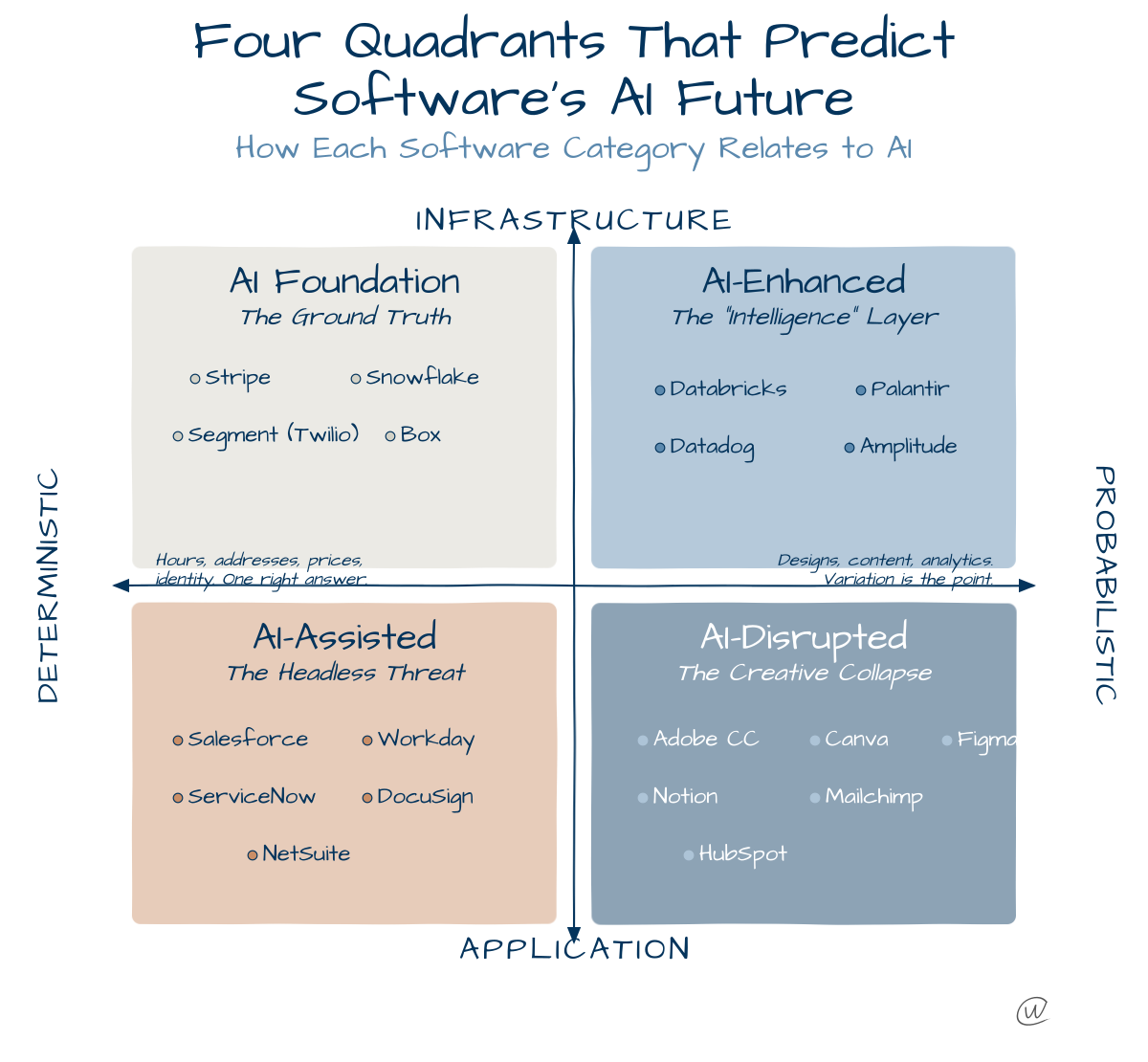
These two axes create four quadrants, and each one has a different relationship with AI.
The Creative Collapse: AI-Disrupted (bottom right, highest risk).
Adobe Creative Cloud, Canva, Figma, Notion, Mailchimp, and HubSpot. These products generate probabilistic output, and that's exactly what generative AI now does natively. The overlap between what these tools produce and what a model can generate from a prompt is almost total. In 'Agents, Assistants, Automations,' I examined how the gap between what vendors call their AI and what it actually does already signals which products are most exposed.
The Headless Threat: AI-Assisted (bottom left, high risk).
Salesforce, Workday, ServiceNow, DocuSign, NetSuite. This is the territory Hoda's piece maps well. Agents can pull the data and route around the interface, but accuracy requirements keep humans checking the work. In 'The 1% Problem (of AI Errors),' I looked at why the better AI gets at these tasks, the harder it becomes to catch the remaining mistakes. These companies still have time to adapt, but the clock is running.
The Intelligence Layer: AI-Enhanced (top right, moderate risk).
Databricks, Palantir, Datadog, Amplitude. These products already work with probabilities, anomalies, and predictions. AI doesn't replace what they do. It gives them better tools to do it with. I think this quadrant is going to thrive for a long time with AI, especially as real-time data and authority from the AI Foundation layer improve.
The Ground Truth: AI Foundation (top left, lowest risk).
Snowflake, Stripe, Segment (Twilio), Box. AI depends on this infrastructure to function, and as more agents run more workflows, demand for it increases. No model is going to improvise a payment amount or approximate an identity credential. In 'When Employees Build Agents, They Encode Decisions,' I argued that every agent someone builds needs verified, structured data underneath to function reliably. This foundational layer provides the deterministic data that must be true in order for the AI to maximize its value.
Where Value Concentrates Next
The $285 billion selloff is priced in a world where AI totally replaces software.
The framework above suggests a different outcome.
AI reorganizes software, and the growth won't be evenly distributed.
It will focus on infrastructure rather than pure applications. The bottom-right quadrant is the most dangerous place to be, but it's also where entirely new product categories emerge if you're willing to rethink what the product is, rather than defend the old version of it.
Evaluate your own stack against this framework. Where does each tool sit? How much of your workflow depends on the bottom-right quadrant? The companies in the AI Foundation layer aren't just surviving. They're what AI needs to function at all.
SaaS isn't dead.
The model is being reincarnated around data and AI, and the companies that own the infrastructure layer are the ones on which everything else gets built.
Proceed accordingly.
Get More Where This Came From
Weekly AI frameworks and data strategy for people who have to make the call.


