From the Newsletter
Rank Is Too Volatile to Be the Whole Story

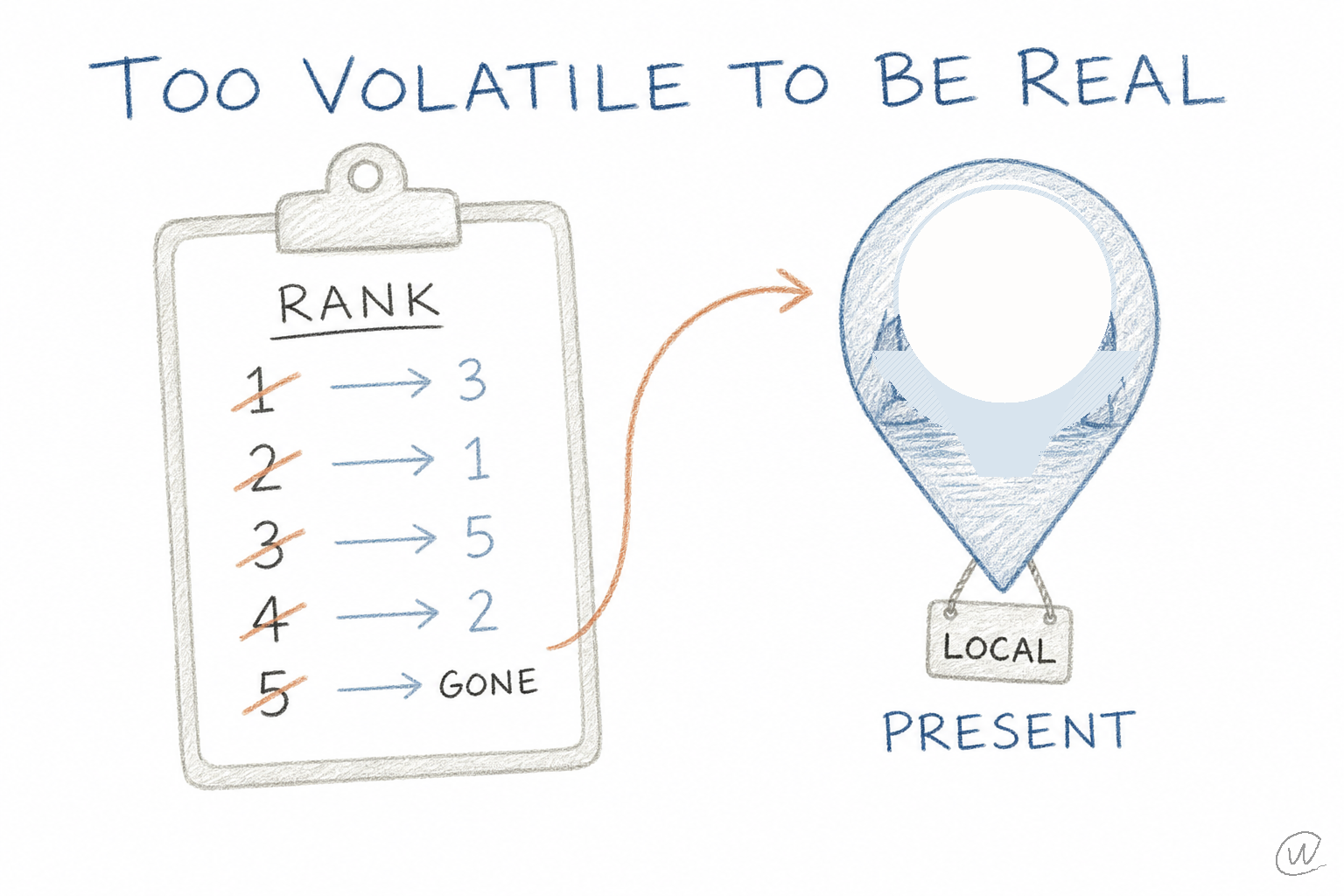
Rank is too volatile to really be real now.
That sounds extreme until you look at what rank asks us to believe. A business can be first in one search, absent from another, and represented differently again in an AI answer.
We keep treating each position as a fact when it is closer to one reading taken by one system at one moment.
Joy Hawkins has now shown the local version of that problem. In her video about Google's May 2026 core update, she found a clear change in local ranking volatility beginning the week of May 18. Across more than 8 million search results, almost 50% of organic rankings became more volatile, and 97% of the reports they examined did too. Yext helped with some of the data for the study.
Joy and Sterling Sky have done useful work here by turning what could have stayed a vague complaint about messy rankings into something you can inspect.
One search is still one location at one moment.
Search Engine Land reported that SE Ranking found an 82% increase in top 10 URLs dropping out of the top 100 during Google’s August 2026 spam update, compared with a no-update July baseline.
During the update, 16.71% of top 10 URLs fell beyond position 100, compared with 9.2% in July. The study covered 100,000 keywords across 20 industries in US organic search. It was not a local ranking study, so it does not support a local-ranking claim. It does show how quickly a position we call “top 10” can disappear.
The AI version of this problem is even less settled.
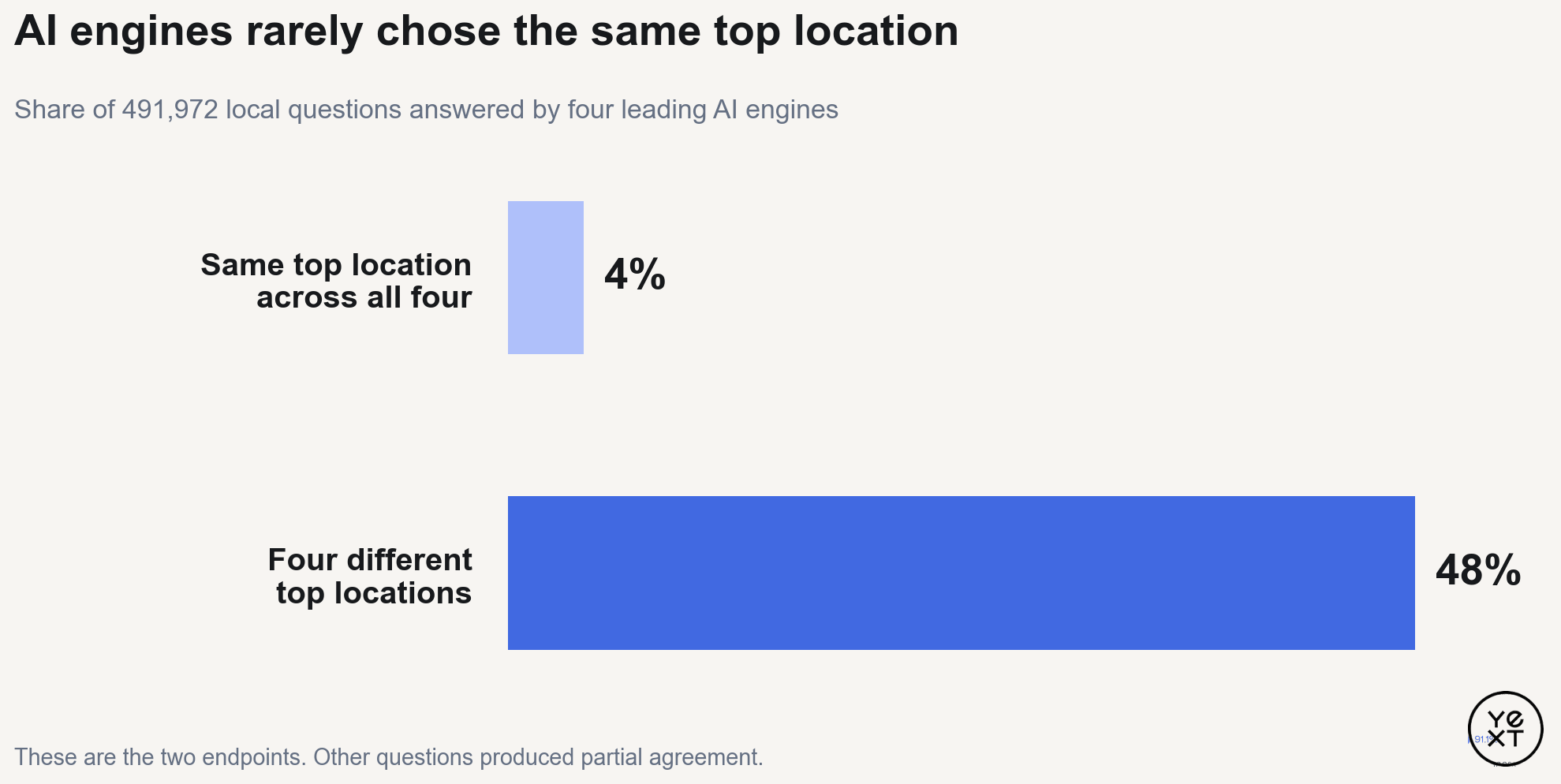
In Anthony Rinaldi’s research, four leading AI engines were asked the same 491,972 local questions between February and August 2026. All four named the same top location only 4% of the time. They named four different top locations 48% of the time.
The disagreement becomes easier to understand when you look at the citations.
When all four engines agreed on a top location, 91% of those locations had their own website among the cited sources. Category directories and mapping services appeared 1.6 to 2.6 times more often when all four agreed.
But the engines did not use the same source mix. One leaned most heavily on first-party sites, another on directories and aggregators, and one used review platforms far more than the others.
A business can look well represented to one system and thinly represented to another because each system is assembling an answer from a different collection of sources, shaped by what it retrieves, what it remembers and the context it gives the question.
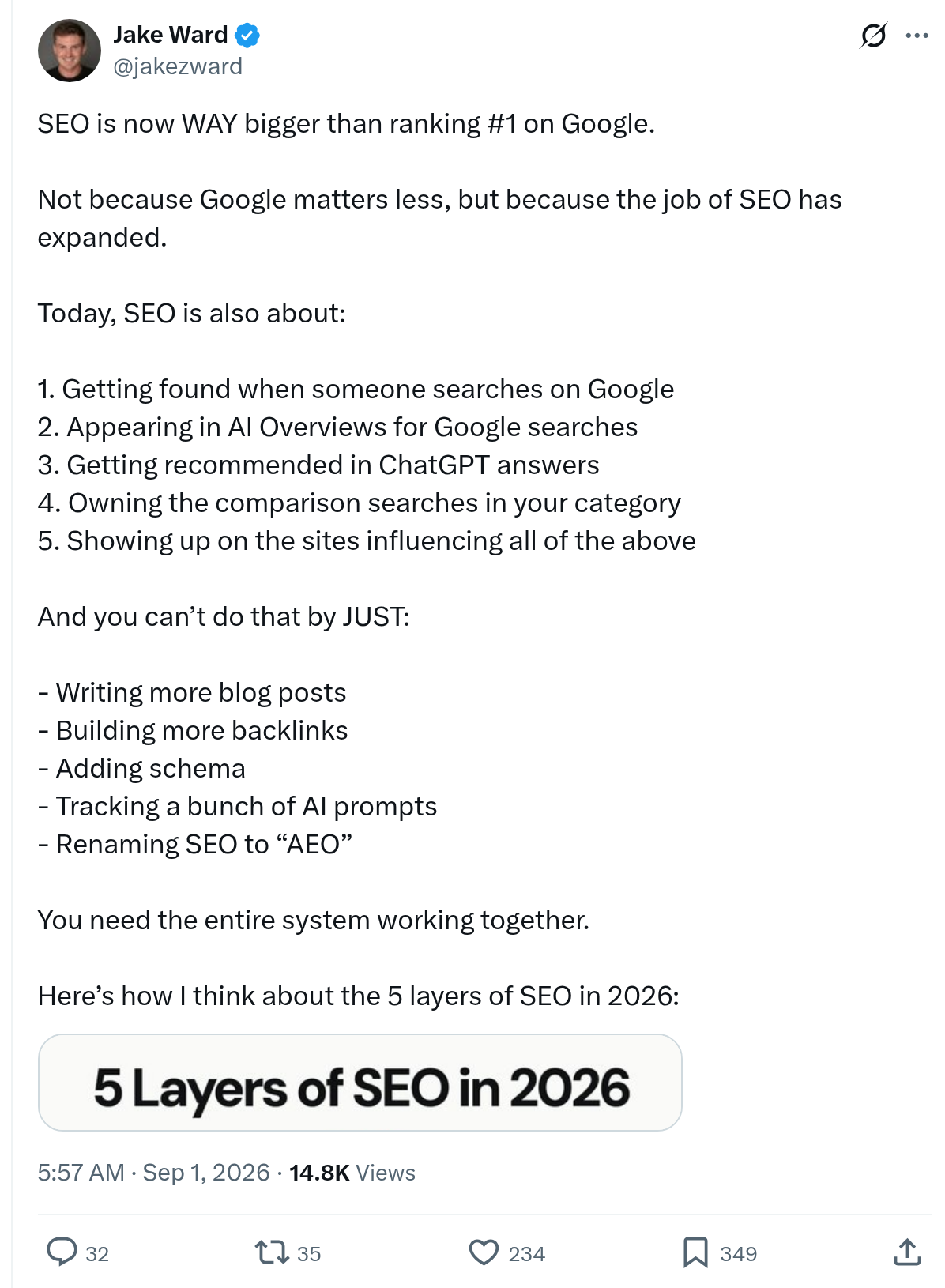
Jake Ward put the expanded job of SEO plainly. “SEO is now WAY bigger than ranking #1 on Google.” His list runs through Google search, AI Overviews, ChatGPT answers, comparison searches and the sites influencing all of them.
Doing that means being present across the sources those systems use.
If rank is one reading, presence is the wider question.
Can people and machines find the business across the places they consult, and do those places agree about the facts?
The new Yext research covered 1,381,768 locations across 759,849 brands.
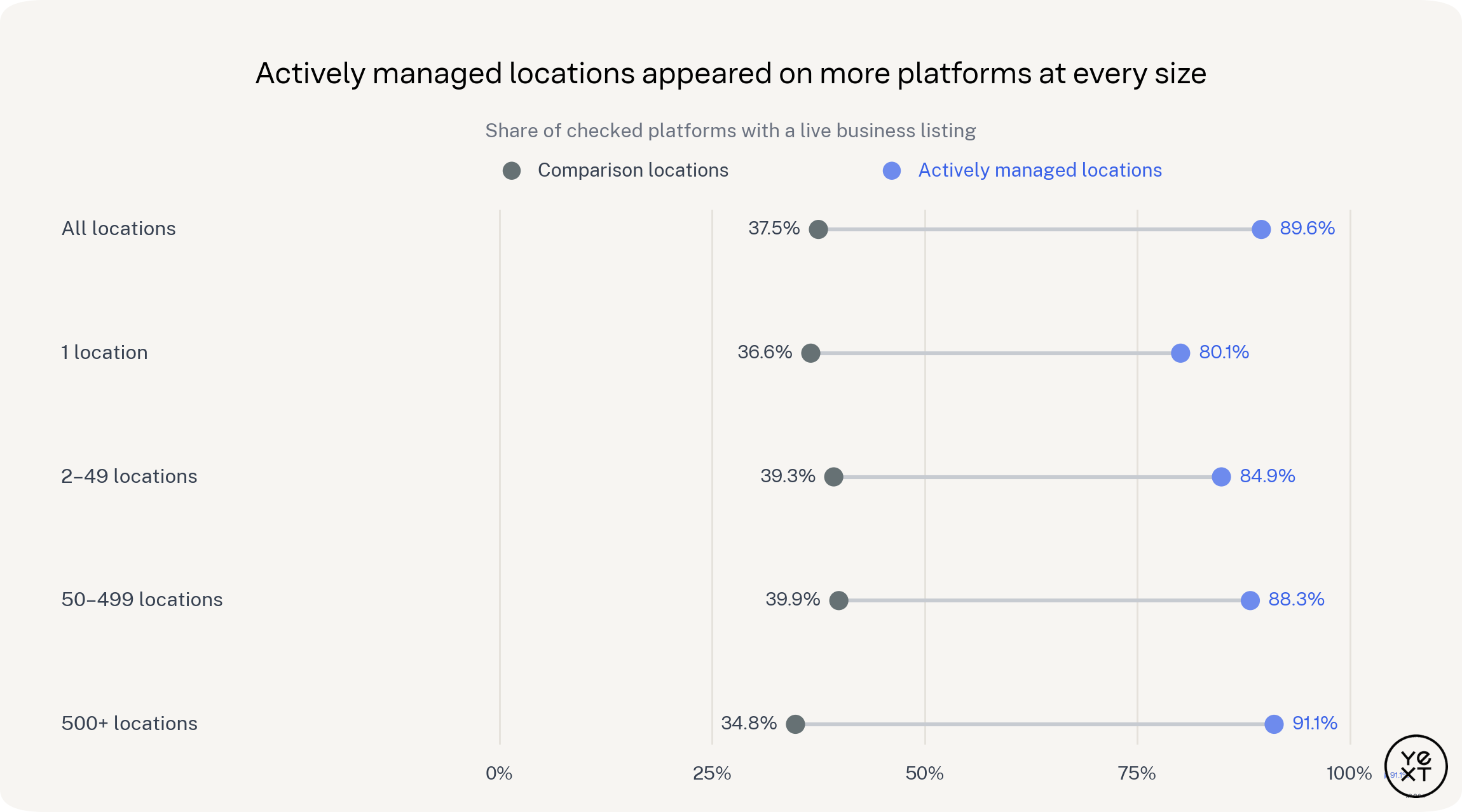
Actively managed locations were found on 89.61% of the platforms checked. Comparison locations were found on 37.47%.
The actively managed rate was 2.39x as high.
For businesses with 500 or more locations, the difference was larger, at 91.07% versus 34.83%, or a 2.61x presence rate. This was not a quirk of one category. Actively managed locations had a higher presence rate in all 10 industries studied.
Coverage alone would still be a fairly bloodless metric. We also need to know whether customers do anything next.
Across 8,997,120 complete location-months, locations on 50 or more live platforms received 150% more total customer actions the next month than locations on 1 to 20.
Calls were 110% higher, website clicks were 163% higher and directions were 161% higher.
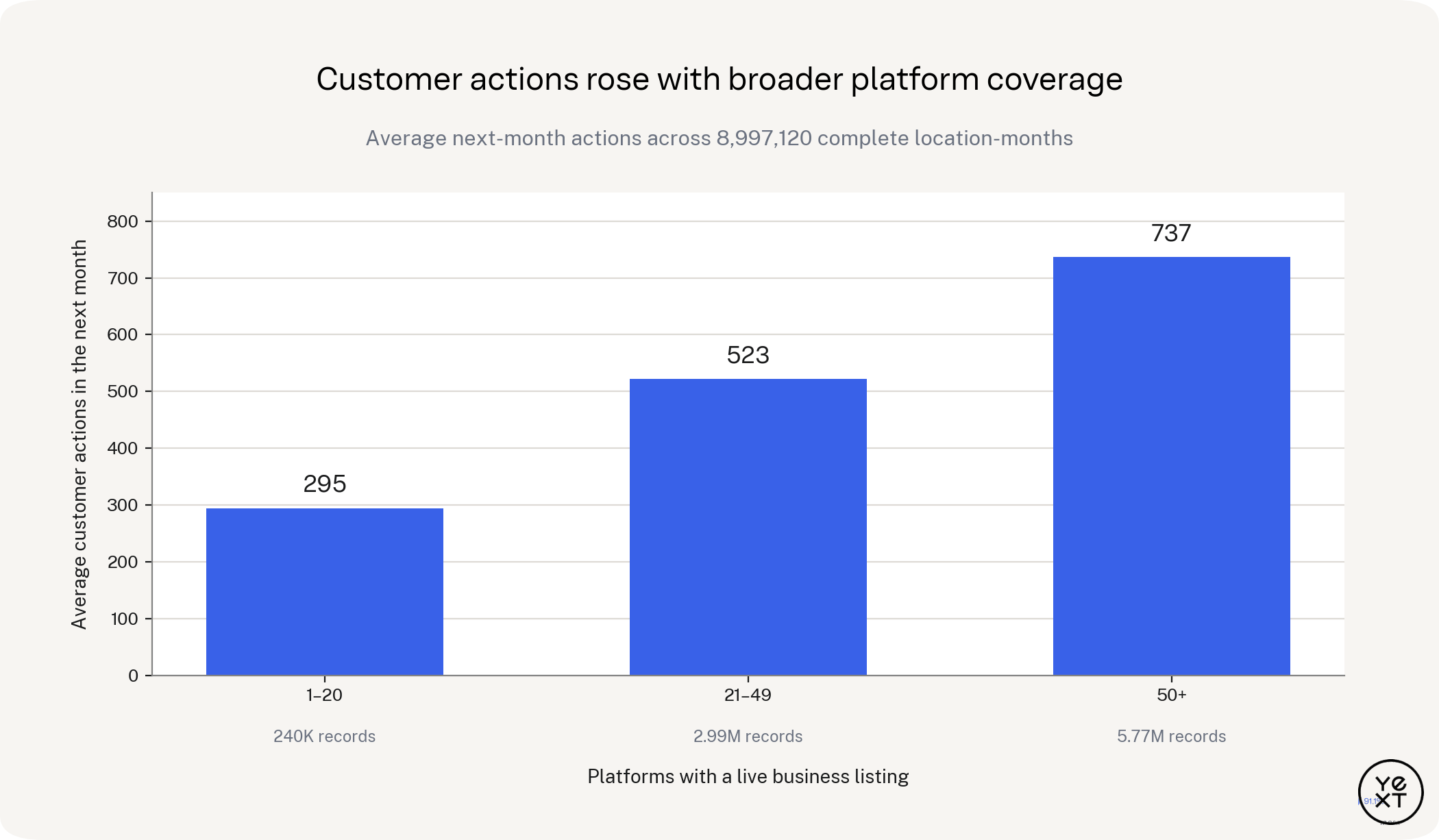
The research used a 12,000-location-month sample from that population to show the wider pattern without pretending every location behaves identically. For calls alone, locations on 50 or more platforms averaged 140 the next month, compared with 66 for locations on 1 to 20.
The total-action result held at every business size, although not evenly. It was 55% higher for one-location businesses, 33% higher for businesses with 2 to 49 locations, 35% higher for those with 50 to 499, and 169% higher for businesses with 500 or more locations.
These are associations. They do not prove that adding a listing makes a phone ring, and they do not turn changing an opening hour into a growth hack. They show that wider presence and more customer activity travel together at a scale large enough to take seriously.
Presence also has to stay current.
Across 2,758,581 brand-month records, one real update day went with more total actions in every business-size group.
“Real” matters here. The update had to change information a customer could see, such as the name, address, phone number, hours, website, categories or services. Daily counters, scans and platform-maintenance events did not count.
These three charts carry the punchlines. Read the full research at yext.com/research.
A rank report can still tell you what happened for a particular query, in a particular place, at a particular moment. Keep it. Just do not ask it to stand in for whether customers can find, trust and act on a business.
At the AI level, memory and context make the answer less like a fixed result and more like a fresh assembly. At the local level, every location can have a different pattern of presence, accuracy and customer action.
Measuring that means tracking where each location is live, whether the customer-facing facts are current, whether the sources agree, where the location appears in AI answers and whether calls, clicks and direction requests follow. Rank still belongs in that work, alongside the evidence of what customers can find and what they do next.
The work now becomes being present, then tracking how you do at scale on a local level.
Get More Where This Came From
Weekly AI frameworks and data strategy for people who have to make the call.


