From the Newsletter
Complete Context Graphs and Why Memory Needs to Forget
Building the memory layer that decides what organizational knowledge should persist, what should fade, and what lives outside your walls

Last week, Jaya Gupta and Ashu Garg at Foundation Capital published a piece that caught fire across the tech world. They argued that context graphs capturing decision traces represent the next trillion-dollar platform opportunity in enterprise software.
This article blew up. And with good reason!
Aaron Levie, CEO of Box, built on their thesis this week. He argues that we're entering the age of context. When AI models commoditize, the differentiator becomes the proprietary context you feed them.
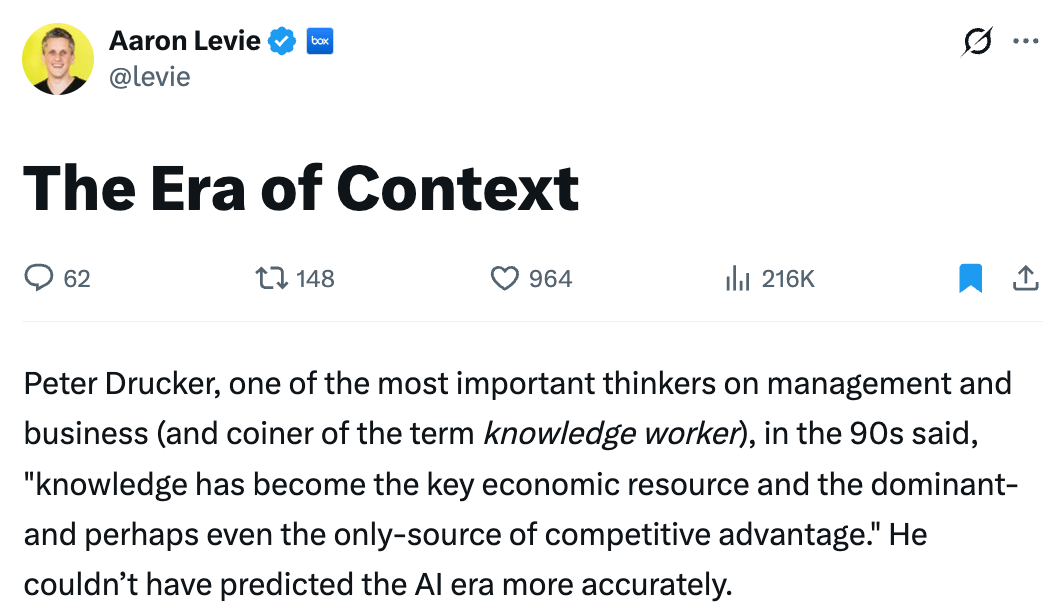
You should read this.
Levie references Peter Drucker's prediction from the 1990s that knowledge would become the only source of competitive advantage.
Kirk Marple, founder of Graphlit, adds another dimension in his piece "Context Graphs: What the Ontology Debate Gets Wrong." His argument is that we shouldn't waste time reinventing entity models when standards like Schema.org already exist. The hard problems are elsewhere, in areas like temporal validity (knowing when facts are true) and resolving conflicting information from multiple sources.
Seriously, the articles this last week… so good.
First, I think each of these authors is correct. And I recommend reading each article if you can (in that order).
Building on their work, I'd like to add three layers of clarification to the picture.
The first layer is understanding that Context Graphs work alongside Knowledge Graphs, not in isolation.
Knowledge Graphs are your system of record containing canonical data about customers, products, and operations, while Context Graphs capture the exceptions, overrides, and decision traces that explain why you broke the rules. Together they tell the complete story of what happened and why it mattered.
The second layer introduces what I call selective memory.
Not all context should persist forever. Business is still human at its core, and irrationality abounds in ways you probably hope the real decision trace forgets. Some decisions are better left undocumented because the actual reasoning may be a trade secret, embarrassing, or counterproductive to preserve.
The third layer recognizes that context isn't just internal.
A competitor opening one block away changes every business decision going forward, yet most context systems are entirely focused on internal decision traces while missing these critical external signals.
I see this every day at Yext, where we use Knowledge Graphs to store vital knowledge for everyone from the world's largest brands down to single-location businesses.
We understand the importance of storing canonical data, but we've also learned that competitive context matters just as much. Our Scout product monitors every competitor a business faces in its regions and categories because external awareness changes internal decisions.

Organizational Memory and the Art of Forgetting
These three articles provide a strong foundation. The piece I'd add is how memory is treated differently across organizations. Not just what you remember, but what you choose to forget. Forgetting is a feature, not a bug. Without it, organizations drown in their own decision history, unable to distinguish signal from noise.
The memory layer requires five distinct capabilities working together.
Persistent Memory holds strategic precedent. These are the decisions that should guide future behavior indefinitely. When your board approves a new pricing strategy or your legal team establishes compliance boundaries, those become persistent. Things that haven't changed in a long time also send their own signal. Long-unchanged decisions should trigger periodic review. "You haven't revisited this in three years. Is this still how you want to operate?"
The Forget Filter separates tactical from strategic, explicit from implicit. Not every decision deserves the same treatment. That discount you gave because of a one-time service failure? Tactical. The restructured deal terms that became your new standard? Strategic.
The filter determines which category each decision belongs to before it gets stored.
Ephemeral Memory applies time decay algorithms. Access patterns matter. A decision referenced weekly stays fresh. One never accessed gradually fades from active recall. This mimics how human memory actually works.
Relevant information remains accessible while irrelevant details naturally decay without manual cleanup.
Temporal Validity tracks when facts are true. A customer's contract value is only accurate as of a specific date. A competitor's pricing is only valid until they change it. Change deltas become signals in themselves. When something changes rapidly, it signals active problem-solving, experimentation, or instability.
When something stays stable, it might be a core business rule or it might be something everyone forgot to update.
Fact Resolution reconciles conflicting signals. Your CRM says the customer is happy. Your support tickets say they're frustrated. Your renewal conversation says they're considering alternatives. Which version is true? All of them, at different moments in time and from different perspectives.
Fact resolution determines which signal takes precedence for which decision.

The Architecture
Based on all of these articles, here's what the components of an organizational AI strategy look like when you pull them together.
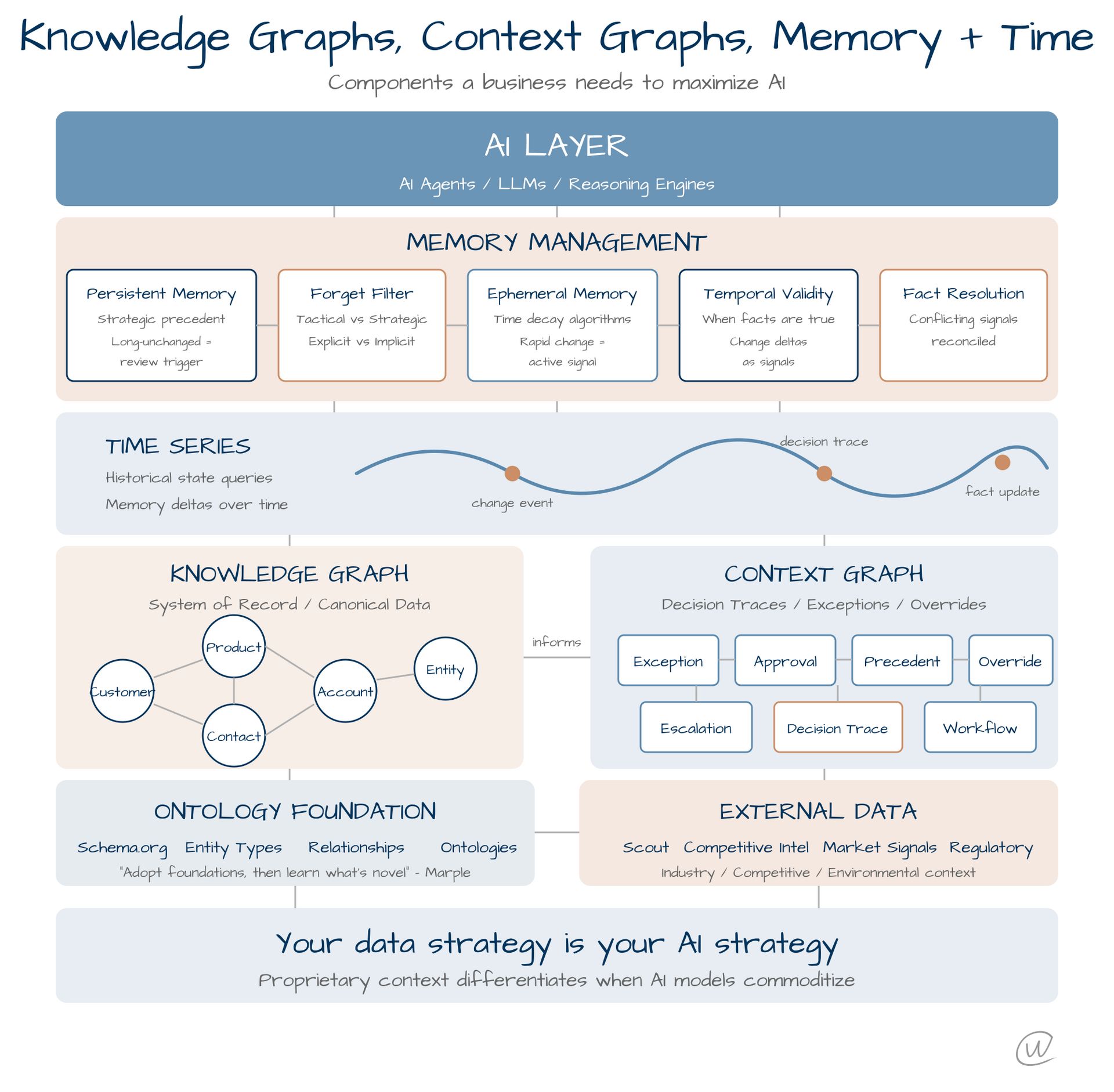
Click to zoom.
The Foundation Layer starts with ontologies and external data. Ontologies provide the entity types and relationships that define your data model. Standards like Schema.org give you a starting point so you're not reinventing basic entity definitions.
External data brings in everything happening outside your walls. Competitive intelligence from platforms like Yext Scout. Market signals from industry reports and news. Regulatory changes from government feeds.
Environmental factors like weather patterns that shift demand without anyone inside your company making a single decision. This foundation layer is what most context discussions miss entirely.
The Knowledge Graph sits on top of this foundation as your system of record. It contains the canonical data about your business. Customers with their contract values and support history. Products with their specifications and pricing. Accounts with their hierarchies and relationships. Contacts with their roles and communication preferences. This is the "what" of your organization.
The facts that should be consistent across every system and every query.
The Context Graph captures everything the Knowledge Graph can't. Exceptions, approvals, precedents, overrides, escalations, and decision traces. When a VP approves a discount that violates policy, that's a context graph entry. When a deal gets restructured due to competitive pressure, that's a decision trace. When a customer escalates through three levels of support before getting a resolution, that's a workflow.
This is the "why" of your organization. The reasoning behind the numbers.
The Time Series Layer tracks how all of this changes over time. Historical state queries let you ask "what did we know on this date?" This matters for compliance, for understanding why past decisions made sense with the information available, and for spotting patterns that only emerge over longer time horizons.
Memory deltas surface signals in large datasets by identifying what's changing rapidly versus what's been stable for years.
Memory Management sits at the top, determining what persists and what fades. This is where the five capabilities described above come together. Persistent memory, the forget filter, ephemeral memory, temporal validity, and fact resolution all work together to ensure the AI layer gets signal, not noise.
The AI Layer consumes all of this to power agents and reasoning engines. Without the layers below, AI agents are just pattern-matching on incomplete data. With them, they have the proprietary context that makes them genuinely useful for your specific business.
This is why a platform like Yext Scout matters. At a very high level, it doesn't matter what everyone in an industry is doing.
What matters is how the industry participants you directly compete against are behaving, as well as new entrants to the market and changes to the products and services they offer. All of this has to be captured and incorporated into context.
Consider a business that sells umbrellas. Weather and weather patterns have always changed the context in which that business operates. A sunny forecast shifts inventory decisions, marketing spend, and staffing levels without anyone inside the company making a single decision.
The context just changed.
Any external data source can reshape the environment in which decisions are made, which is why context is much larger than just the knowledge that isn't captured in a CRM.
The Gallagher Principle: Structure Doesn't Dictate Usage
Language offers a great analogy for how the structure of things doesn't necessarily dictate how they are used. The format in which words are composed of letters doesn't tell us much about how they are pronounced in real life.
The comedian Gallagher, best known for smashing watermelons with his "Sledge-O-Matic," often started his sets with sharp observational wordplay about the frustrations of English.
In one famous bit, he walks through how words with nearly identical spellings are pronounced completely differently.
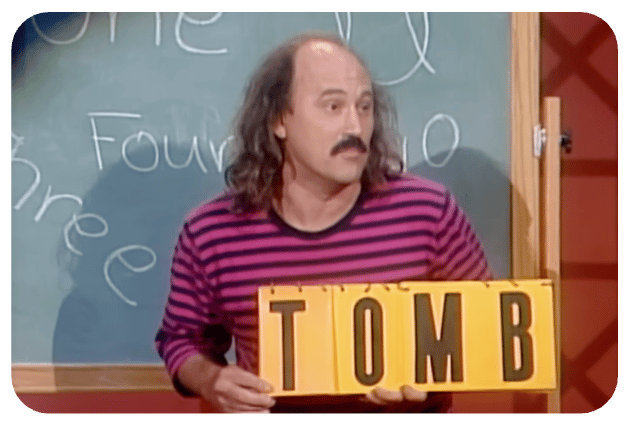
This is some great 20th-century comedy.
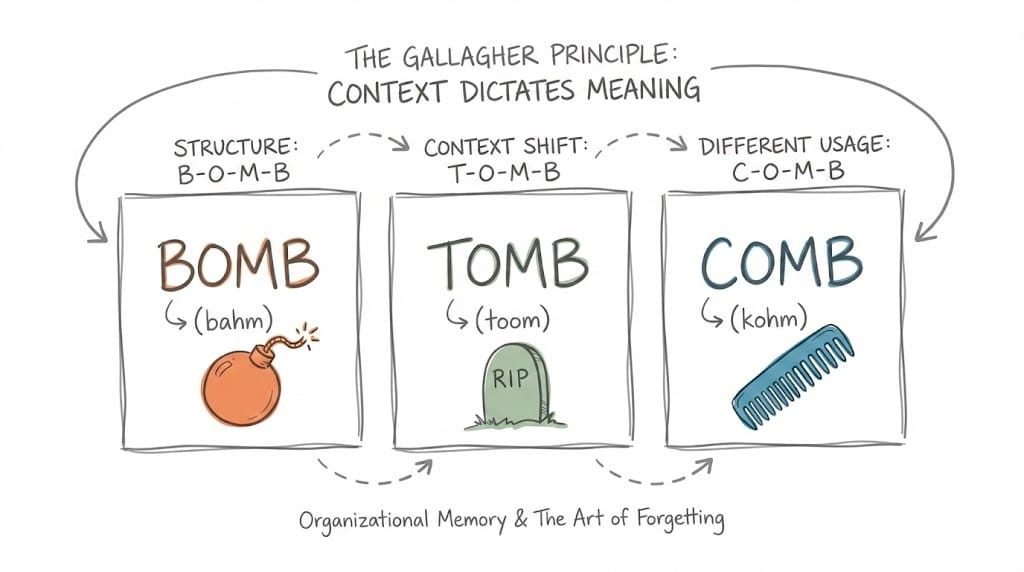
He starts with B-O-M-B. That's "bomb" (bahm). Easy enough.
Then he flips the B to a T. If B-O-M-B is "bomb," then T-O-M-B should be "tom," right? No, that's "tomb" (toom).
So he flips the T to a C. If T-O-M-B is "tomb" (toom), then C-O-M-B should be "coomb," right? No, that's "comb" (kohm).
It's a classic sketch.
Similar to language and pronunciation, different things need to be remembered in different ways for different purposes. I find this a helpful frame when thinking about structure, storage, recall, and usage.

Building Context Systems That Know What to Remember
The path forward requires context systems that treat temporal dynamics as genuinely powerful signals. Both the rate of change and the absence of change carry important information.
Memory deltas and changes over time are excellent ways to surface signals in large datasets. When something changes rapidly, it signals active problem-solving, experimentation, or instability that deserves attention.
When something hasn't changed in a long time, it may signify a persistent business rule that leadership should periodically review. These stable patterns should trigger occasional check-ins. "You haven't looked at this in a while. Is this still how you want the business to operate?"
Temporal validity remains a genuinely unsolved infrastructure. Building systems that recognize these patterns transforms context from passive storage into active organizational intelligence.
Beyond internal decision traces, your context graph needs real-time feeds about competitive moves, market changes, regulatory shifts, and industry dynamics.
A competitor's product launch should automatically reweight the context around pricing decisions. New regulations should trigger a review of affected decision traces. This external awareness transforms context from a backward-looking audit trail into a forward-looking intelligence system.

Humanity and AI Working Together
I've always loved that Barksdale quote. It's one of the most famous lines in business, and I've seen Chief Data Officers try to use it with their teams countless times.
But I'd modify it slightly for where we're headed:
If we get knowledge graphs, context graphs, memory, and temporal understanding even remotely solved and combined in the next year or two, it is going to change our focus.
We will be really focused on the human element.
Those opinions Barksdale is talking about. These are decisions that will be helped by AI, but humanity should shine through.
I would argue that this is what ALL TECHNOLOGY & INNOVATION is about.
Increasing the time we have to be human.
The reason I bring this up is that if you're at all nervous about how fast things are moving (and I am, because I can see real implications), consider this. Getting this organizational AI model functioning is going to free up a lot of time. That time allows us to discuss the opinions, attitudes, and thoughts of humans, where AI can assist but not replace.
That has always been one of the true difference-makers in success or failure.


