The Broken Pool Cue: Why AI Adoption is Now a Test of Will
Technical Barriers are Gone... Now We Find Out Who Actually Wants the Job

Christian J. Ward
Jan 19, 2026
There's a scene in The Dark Knight where the Joker walks into a room full of mobsters, breaks a pool cue in half, and drops the two pieces on the floor.
"We're going to have tryouts," he says.
Only one person is walking out of that room with a job (or alive, for that matter).
I thought about this scene when talking with a friend about AI adoption in their organizations. Whether executives want to admit it or not, that's exactly what's happening right now.
And the process for every individual to benefit from AI in their careers is really going to come down to their desire to succeed. The people with the highest agency are going to be fine, but those are the ones diving for the pool cue!

AI Adoption is Hard in the Enterprise
I was talking to Scott Murtaugh last week about AI enablement. He's been consulting with companies trying to help them adopt AI, and he's hit the same wall over and over again.
"The problem," he said, "is that everyone is asking their employees to help automate their own jobs. Of course, they're going to resist."
He's right. The standard corporate approach to AI adoption is backwards. Management buys licenses for everyone, announces an "AI initiative," and then waits for magic to happen. When nothing changes, they blame the tools or the training.
When you tell employees to "find ways to use AI," what many of them hear is: "Please help us figure out which parts of your job we can eliminate." You're asking turkeys to vote for Thanksgiving.
And some of them aren't just resisting. They're actively sabotaging.
I wrote about this in "The AI Perception Gap" last year. A WriterAI survey found that 41% of Millennial and Gen Z workers admit to actively sabotaging their company's AI strategy. They're refusing to use the tools, creating workarounds, and sticking with familiar processes.
The resistance is understandable, but companies now recognize that AI is here to stay and must be incorporated for them to compete. It is not an optional approach, as many management teams had hoped.
This is leading to career divergence, where the early adopters are skyrocketing ahead in their jobs or their attractiveness to better employers. Late adopters can survive, but if you are a manager and you have one employee that can do the work of four others because of an effective AI approach… who are you keeping?
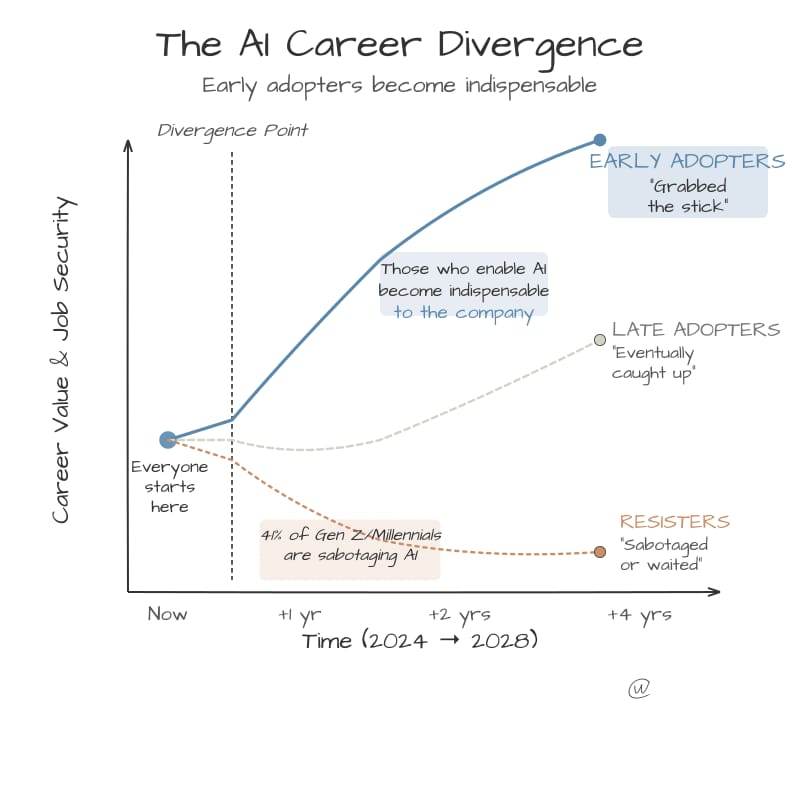
If there are going to be fewer jobs due to AI, you'd better be on the blue path.
The people who grab the cue stick early aren't just getting ahead in the short term. They're becoming indispensable. They're the ones who understand how to make AI work for their specific domain. They're the ones executives turn to when they need results.
The people who resist? They're betting their careers on AI adoption failing.
That's a bad bet.

What Works Better
Scott and I talked about how a different approach and what works to boost AI adoption.
Instead of rolling out AI tools to everyone and hoping for the best, one company ran an actual selection process. They asked people to apply.
They picked 25 high-agency employees. Flew them to a central location. Trained them on the tools. Each person picked a different AI platform to specialize in. Each got assigned a project in their own domain.
The result? Engagement instead of fear. Those 25 people became internal champions. They built things. They showed others what was possible. They created a flywheel.
This approach works because it recognizes reality. Not everyone is going to grab the stick. Not everyone wants to. And that's fine.
But the ones who do? They need to be identified, empowered, and given room to run.
More on this below, where I’ll share what else is working for AI Adoption.
The People Who Grab the Stick
Kevin Kelly wrote The Inevitable in 2016 about the technological forces shaping our future. His core argument is that some technologies aren't just trends.
They're inevitable. AI has long since passed into this category, but more importantly, it will accelerate the inevitability of many more technologies.
This is the essence of what Ray Kurzweil calls the Law of Accelerating Returns, the idea that innovation compounds because each breakthrough accelerates the next.

This is a fantastic read - highly recommend it!
Kelly's insight is that early adopters of inevitable technologies don't just get ahead. They also set the pace. They shape how those technologies evolve. The people who learned to code in the 1990s didn't just get programming jobs. They built the companies that defined the next three decades.
Let me say this again… AI is one of those inevitable technologies.
I wrote about this concept last April, "Agency Beats Intelligence in AI Development."
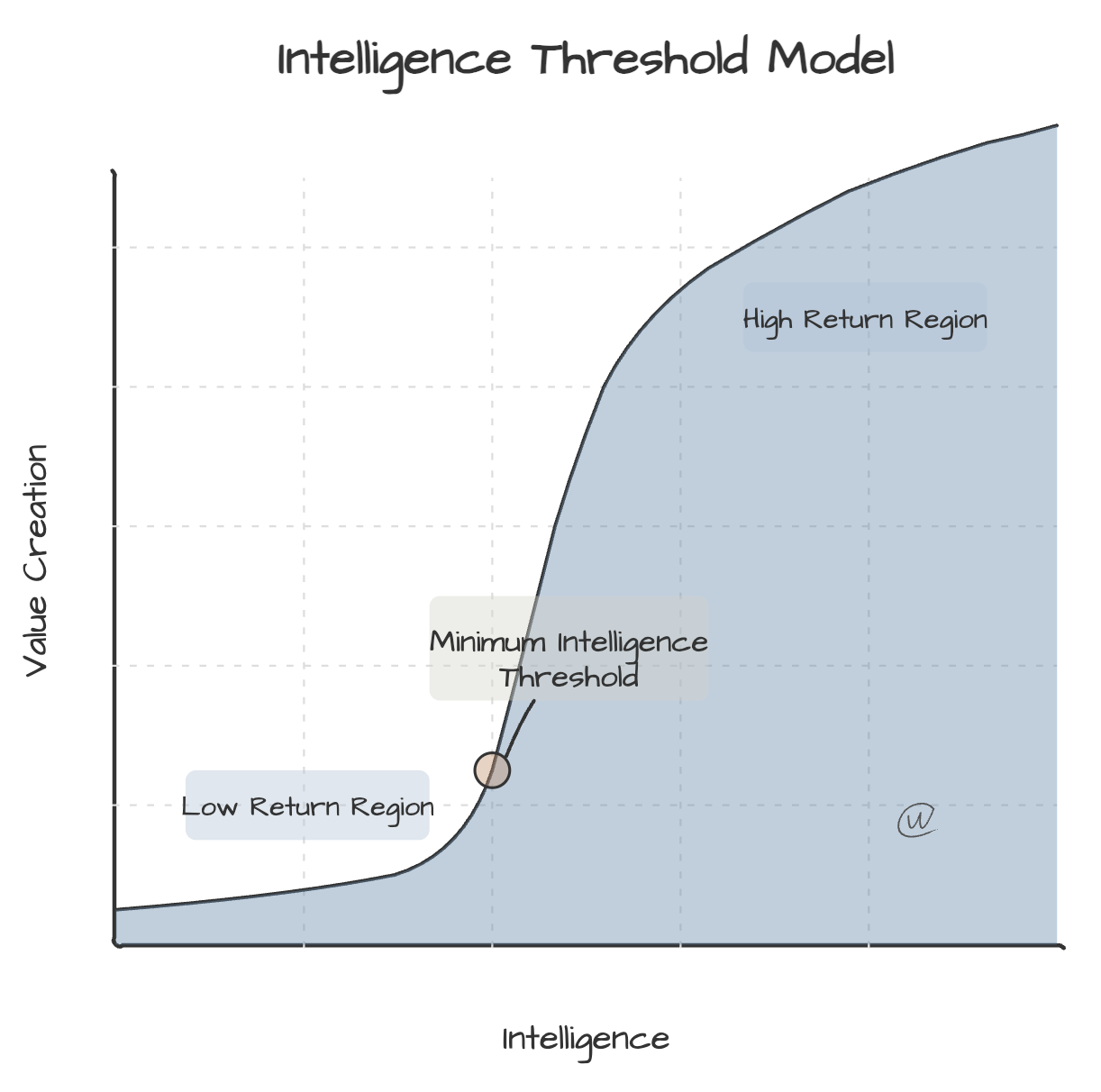
Andrej Karpathy's insight that action beats planning applies here, too. Once you cross a minimum intelligence threshold, agency becomes the differentiating factor.
And this time, there may not be another job waiting for you as readily as in the past.
Stop waiting for your job to “enable” you on AI. Go get on YouTube, X.com, or any other platform with countless tutorials, videos, and guides to help you get started.

Claude Cowork = The Excuses Just Evaporated
For a long time, low-agency employees had a valid shield: 'It's too technical.' With the release of tools like Claude Cowork, that shield is gone. The technical barrier has been lowered so far that the only thing left standing is your willingness to try.
You needed to understand terminals, IDEs, and installation processes. Even getting Claude Code running meant downloading things, configuring paths, and troubleshooting errors. It isn’t terrible, but for the truly non-technical, it seemed pretty arduous.
That excuse just evaporated.
Introducing Claude Cowork.
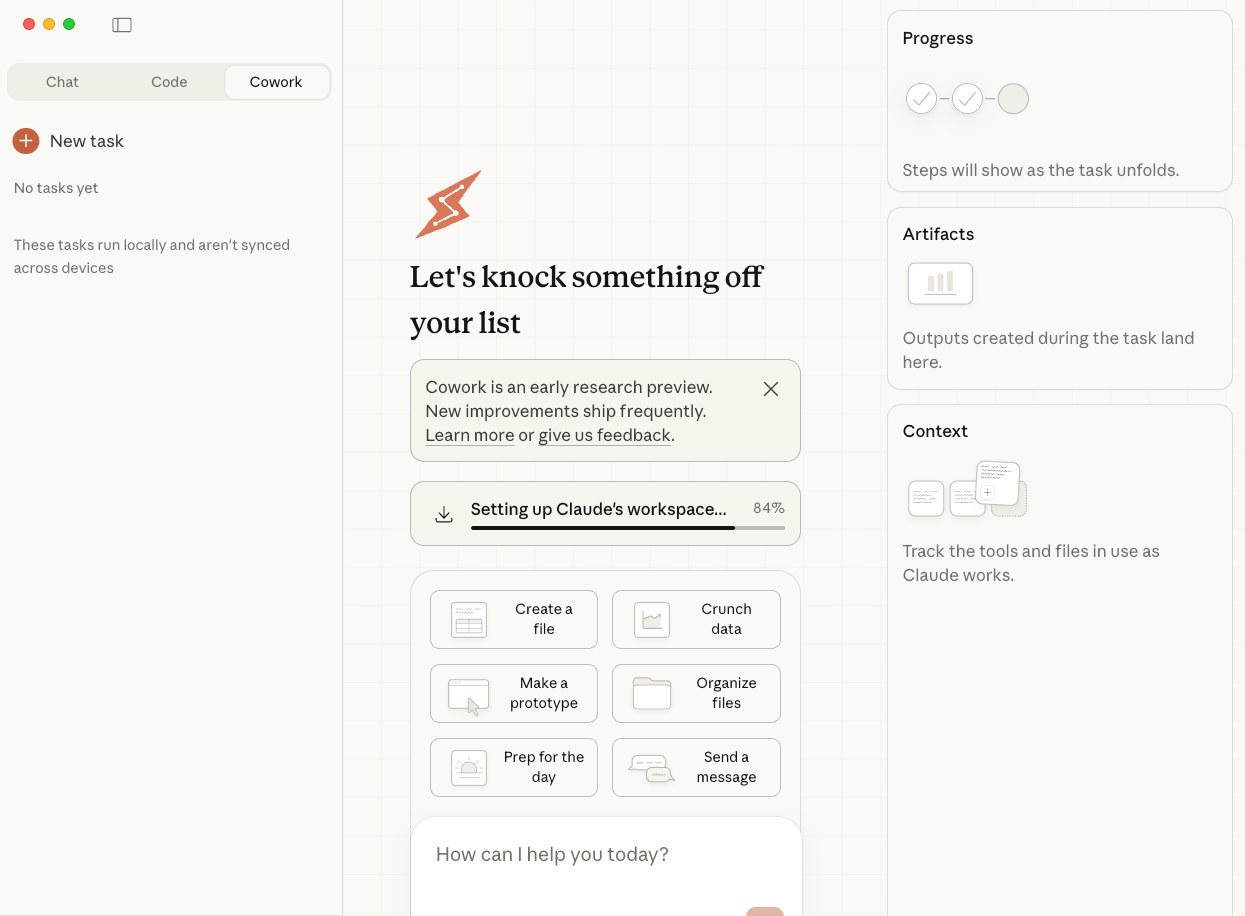
With the launch of Claude Cowork, the technical barriers that held people back are gone. Just download the Claude desktop app, and you are off to the races with something between the typical AI chat interface and a full version of Claude Code.
You don't need to understand terminals. You don't need to figure out the difference between planning mode and agent mode.
Cowork handles it.
The interface looks like the Claude you already know. But now you can maintain context across sessions. Store files. Build on previous work. The AI understands when to ask questions and when to execute. It's the best of conversational AI and agentic AI in one package (so far).

What IS Working to Drive AI Adoption from My Experience
The technical barriers are gone. The only barrier left is organizational.
I have seen strategies fail, and I have seen what actually moves the needle. It is not mandatory training videos or blanket license distribution.
It is a specific 5-step framework.

1. Ask for Volunteers
Do not draft people into AI initiatives. Forced conscription breeds resentment and the kind of sabotage I mentioned earlier. Adoption relies entirely on personal agency.
As Scott Murtaugh said, “You cannot mandate curiosity.”
You have to ask for volunteers, then be selective. Look for the high agency individuals who are already raising their hands. These are your pilots.
2. Set Expectations on Time Commitment
Be brutally honest about the workload. Frame this opportunity like getting an MBA at night. This is not something that happens exclusively during standard working hours between meetings. It requires deep work. It requires nights and weekends. If you frame it as a casual learning opportunity, it will fail.
Frame it as a rigorous tryout, and you will get the people who actually want the pool cue.
3. The First Project Must Be Personal
This is counterintuitive for corporate strategy but essential. The first project should not be a work project.
It must be a passion project.
When someone builds something they genuinely care about, they push through the frustration barrier. One team member I know used the tools to build a full fantasy NASCAR system. It had nothing to do with our bottom line, but it taught him more about data structures and coding agents than any corporate seminar could have. He told me he got into a rabbit hole and could not get out. He realized he could build anything with Claude Code. That is the moment of conversion.
4. Cross-Functional Team Composition
Once the passion projects are done, you form the teams. Do not silo them. Pull from multiple disciplines like operations, marketing, finance, and engineering.
This is where you pivot to real business projects. When you have high agency people from different domains speaking the same AI language, the solutions they build are often things management never would have thought to ask for.
5. Track and Display Adoption
Accountability comes from transparency. Build a usage dashboard. Show the adoption metrics visibly to the cohort. Who is running prompts? Who is building agents? Who is falling behind? When adoption is tracked and displayed, it gamifies the process. It makes it clear that this is not a passive initiative.
It is a leaderboard.
The Opportunity
The companies that figure out AI adoption won't do it by buying everyone licenses and hoping for the best. They'll do it by finding their high-agency people, giving them real tools, and getting out of the way.
If you're one of those high-agency people, this is your moment.
The barriers are gone. The tools are accessible.
The pool cue is on the floor. Pick it up.