The Verification Trust Problem
AI Need Multiple Signals for Us to Trust the AI (and other Circular Problems)

Christian J. Ward
Dec 8, 2025
Trust is the currency of AI.
While this might sound like marketing copy, it actually describes the core economic reality facing every business today.
The Latin roots verus (true) and facere (to make) come together to form verification, the process of establishing the truth, accuracy, or validity of something.
This concept has shifted from a human activity to a computational requirement, reshaping how businesses must think about data.

The Asymmetry of Verification
Jason Wei, a researcher at Meta and formerly at OpenAI, published about asymmetry of verification.
Some tasks are far easier to verify than to solve. This asymmetry determines what AI can master because anything that can be measured can be optimized.
Wei's examples are helpful here. Sudoku puzzles require enormous effort to solve but trivial effort to check.
Writing code takes engineering teams years, yet verifying if the site works takes only minutes. Mathematical proofs require genius to create, but are more straightforward to validate.
His insight leads to the "verifier's rule" where the ease of training AI to solve a task is proportional to how verifiable that task is.
Tasks that are objective, fast to verify, and scalable to check will inevitably be solved by AI.
But the inverse is true, too. Wherever verification remains difficult, there will be difficult discussions on how best to provide answers with AI.
Human judgment still matters there, and brand data quality determines outcomes.
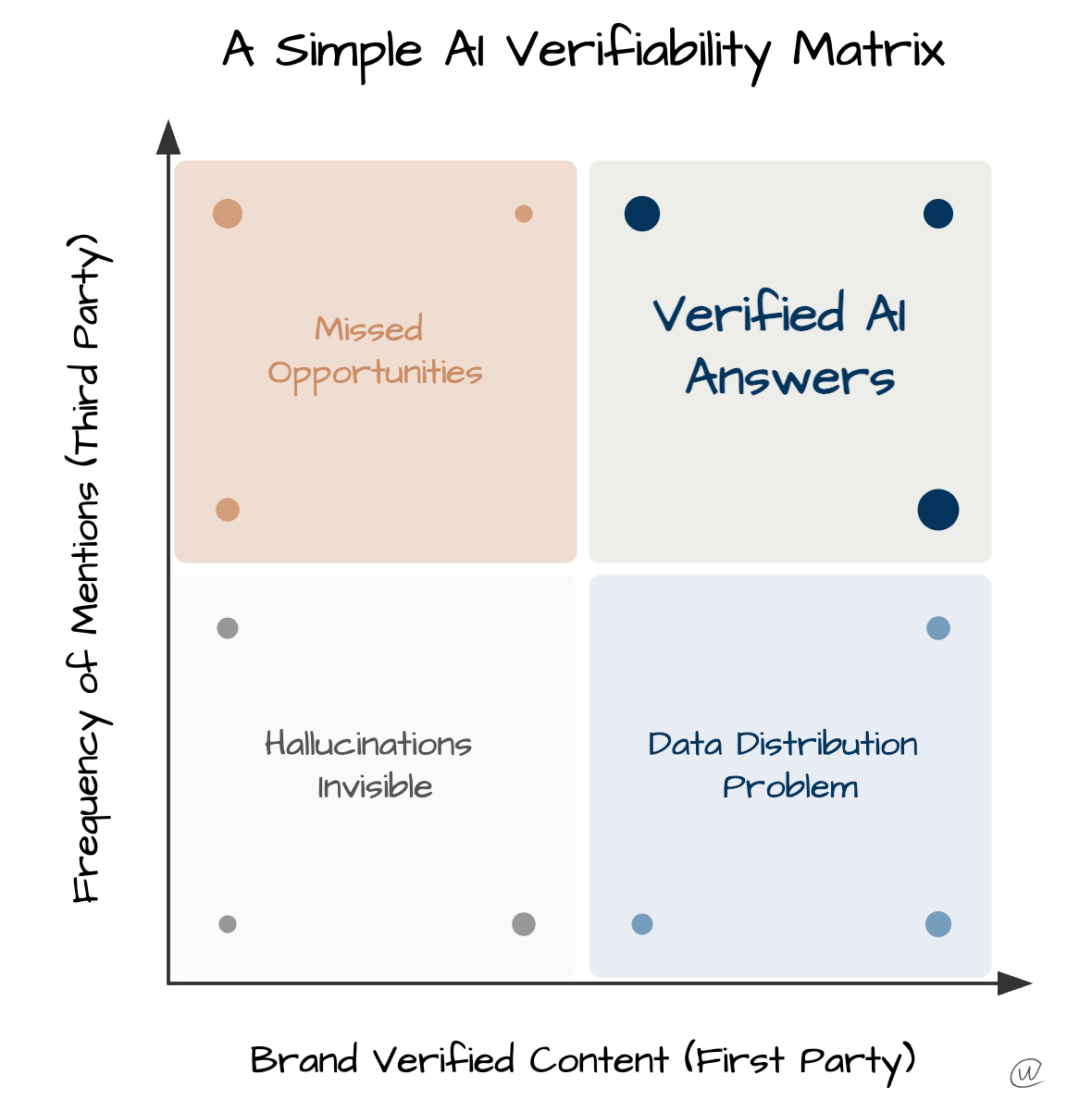
I mean, it’s not that simple. In a nutshell, you have to do both.
The Verification Pipeline - Guardrails, Grounding, & Verification
We also need to look at verification not just as a final stamp of approval, but as part of a multi-model or multi-step process. AI is no longer a black box that spits out a single answer; it is evolving into a complex assembly line of checks.
First, we know that many AI platforms now use safety guardrails. This is the first element of override, where complex rules prevent the model from engaging in harmful or prohibited topics.
These aren't strictly probabilistic in the true sense anymore; they are gates.
Then we have multiple models, often referred to as MoE (Mixture of Experts). In this setup, if a user asks a local question or a timely question, the system routes it to a specific expert. It will actually check the web to ensure that data is there. That’s called grounding, which is fundamentally different from relying solely on training data.
The AI recognizes it doesn't "know" the current weather or the price of a stock, so it verifies against live web data.
Finally, we have very specific use cases in which the output is formatted as a particular type of response.
Whether that is a product card, a shopping list, or a local map, the AI is evolving to build around experiences, not just text generation. And each experience will have a different verification process.
What that means is each step probably has a very different verification platform. In many ways, I believe that easily verifiable data will occur earlier in the pipeline, during the safety check or the initial routing. Information that is harder to verify will come later. The AI will eventually have the autonomy to choose whether to verify and, if so, to what extent, based on the complexity of the query.
This is a very big change from the single-step inference of the past.

Why Single Sources Fail Probabilistic Systems
I spend my professional life thinking about how brands get information into AI systems, and my work has taught me something the SEO community resisted.
In the simplest terms, tactics cannot overcome bad data.
Traditional search optimization assumed manipulation; link building, keyword density, and page structure created an industry devoted to gaming algorithms. While some of it worked (and much of it still does in traditional search), large language models operate differently.
These are probabilistic systems that weigh multiple signals to assess likelihood. A single source claiming something creates just one data point, whereas multiple independent sources confirming the same information create a probability that approaches certainty.
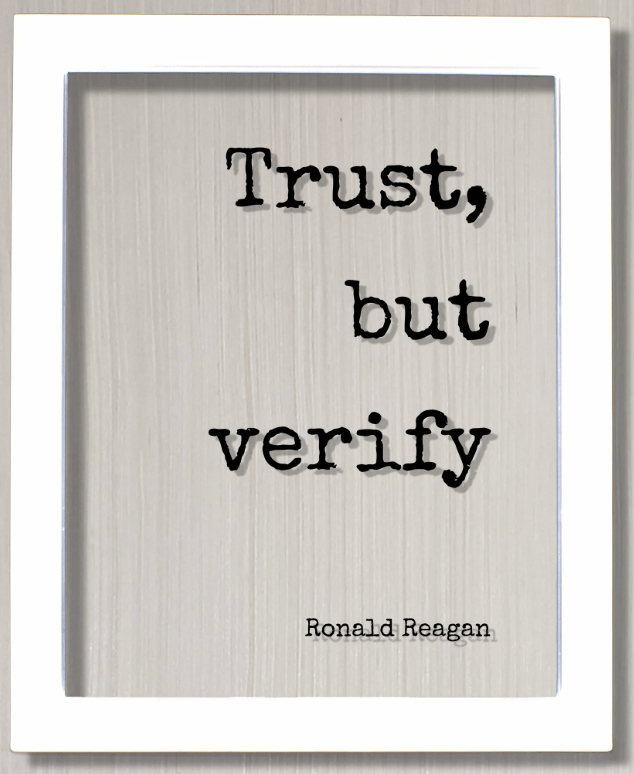
I mostly use this in parenting teenagers, thanks to “Find My.”
In the age of AI, however, the dynamic has shifted.
Now, we must verify in order to trust. Just stick with me for a minute…
This is why third-party data distribution becomes essential rather than optional. When your business hours exist only on your website, an AI system has exactly one source to trust. However, when your business hours exist on Google, Apple, Facebook, Mapquest, Yellowpages, and fifty other platforms, the AI system has corroborating evidence, which significantly increases confidence.
Brands that understood this shift years ago built competitive moats, while those still debating whether third-party platforms matter are watching their AI visibility evaporate and wondering why their SEO metrics still look fine.

Memory Meets Verification
Memory is the next battleground in AI development. Sam Altman has confirmed that GPT-6 will prioritize memory integration, Claude already maintains memories, and Google's AI systems are building persistent understanding.
Memory without verification creates (the opportunity) for dangerous hallucinations at scale because an AI system that remembers incorrect information will propagate that error across every future interaction. To prevent this, systems need mechanisms to verify and update knowledge, making verification inseparable from trust.
Brands must become the verified source that AI systems trust.
But here is the uncomfortable truth most CMOs have always struggled with.
You cannot be the only source.
Verification requires external confirmation. If the only entity claiming your business opens at 7 AM is your business, the AI has limited confidence in that claim. If your claim matches data from multiple independent platforms, confidence increases.
This principle extends to everything.
Product specifications, service offerings, pricing, locations, staff credentials, and customer reviews. The brands that will win are those building verification infrastructure across the entire ecosystem.

Building for Verifiable Truth
Start by auditing every public claim your business makes; anything that would help a consumer on their journey.
You can use AI to do this. Feed AI (any model) your brand, products, or services and ask for every fact it can find about what you offer, what you do, and who your brand represents. This reveals what’s already out there, so you can design a data strategy that organizes that information.
At Yext (where I work), we use knowledge graphs to organize this data, ensuring it is structured for easy distribution and verification.
Invest in structured data as a strategic asset. Schema markup and knowledge graphs transform your information from unstructured text into structured assertions that AI systems can consume directly, improving verification speed and accuracy.
Distribute to third-party platforms as verification infrastructure. This is not about SEO backlinks (which are fine but probably not the future). It is about creating multiple independent confirmation points. Every platform that accurately reflects your business data becomes a node in your verification network.
Monitor AI responses about your brand continuously. The verification loop requires feedback. When AI systems make incorrect claims, you need mechanisms to identify errors and trace them back to source data problems, because fixing the symptom without fixing the source guarantees the error will return.

The Limits of Brand-Controlled Verification
Brands cannot fully control their own verification because customer reviews, media coverage, and social media commentary all exist outside their control.
While this lack of control frustrates marketers, it comes with a gain in credibility. Information that exists only where brands control it carries less weight, whereas information that exists across independent sources carries more weight because coordination would be difficult to fake.
The solution is not to fight for control, but to compete for accuracy. Brands that maintain genuinely accurate information earn verification advantages, while those attempting to manipulate signals create conflicts that AI systems detect and penalize.
Trust has always been currency, but what changes with AI is the mechanism of exchange. Humans assess trust through reputation, whereas AI systems assess it through verification signals. The brands that understand this shift will structure their data for verification.
The asymmetry of verification means AI will master verifiable tasks first, so make your brand information one of them.