From the Newsletter
AI Is Adopting Us
Opus 4.8 is a reminder that the adoption curve is moving under our feet

Claude Opus 4.8 came out last week, and my early reaction is pretty simple.
It is outstanding.
Anthropic called it a "modest but tangible improvement" over Opus 4.7 in the Claude Opus 4.8 launch post on X. That may be right for a release note, but it does not describe what happens when you put it against real work.
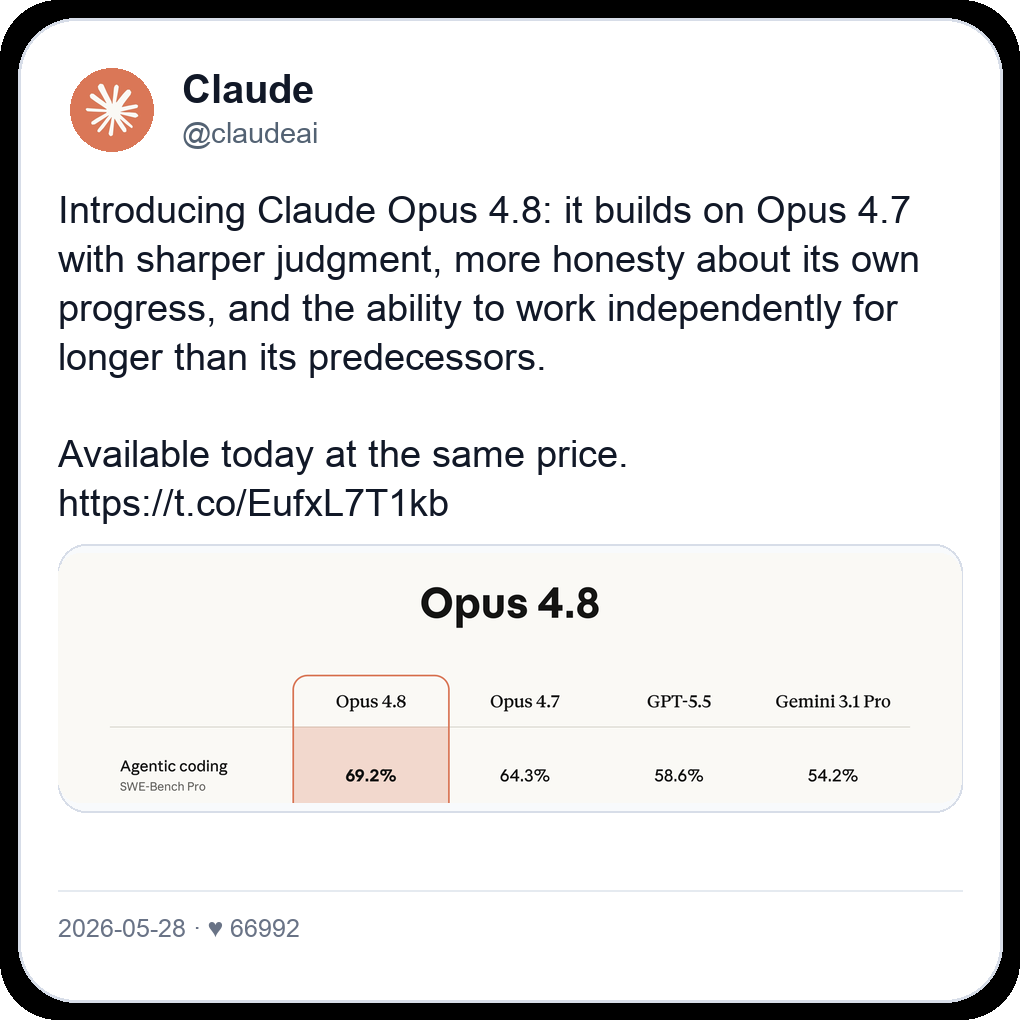
In my own testing, Opus 4.8 feels closer to the category of model I thought ChatGPT 5.5 had opened up. It makes me feel better about the jump I made from Claude 4.7 to Codex 5.5 for a lot of the projects I have been working on.
Opus 4.8 has single-shot a few things against large data sets that I would have expected to require more scaffolding, more retries, and more hand-holding. It has also been better at maintaining voice, which changes whether a first pass feels worth editing or needs to be rebuilt.
The model did not merely get a little stronger. The experience of adoption changed because the thing being adopted changed underneath us.
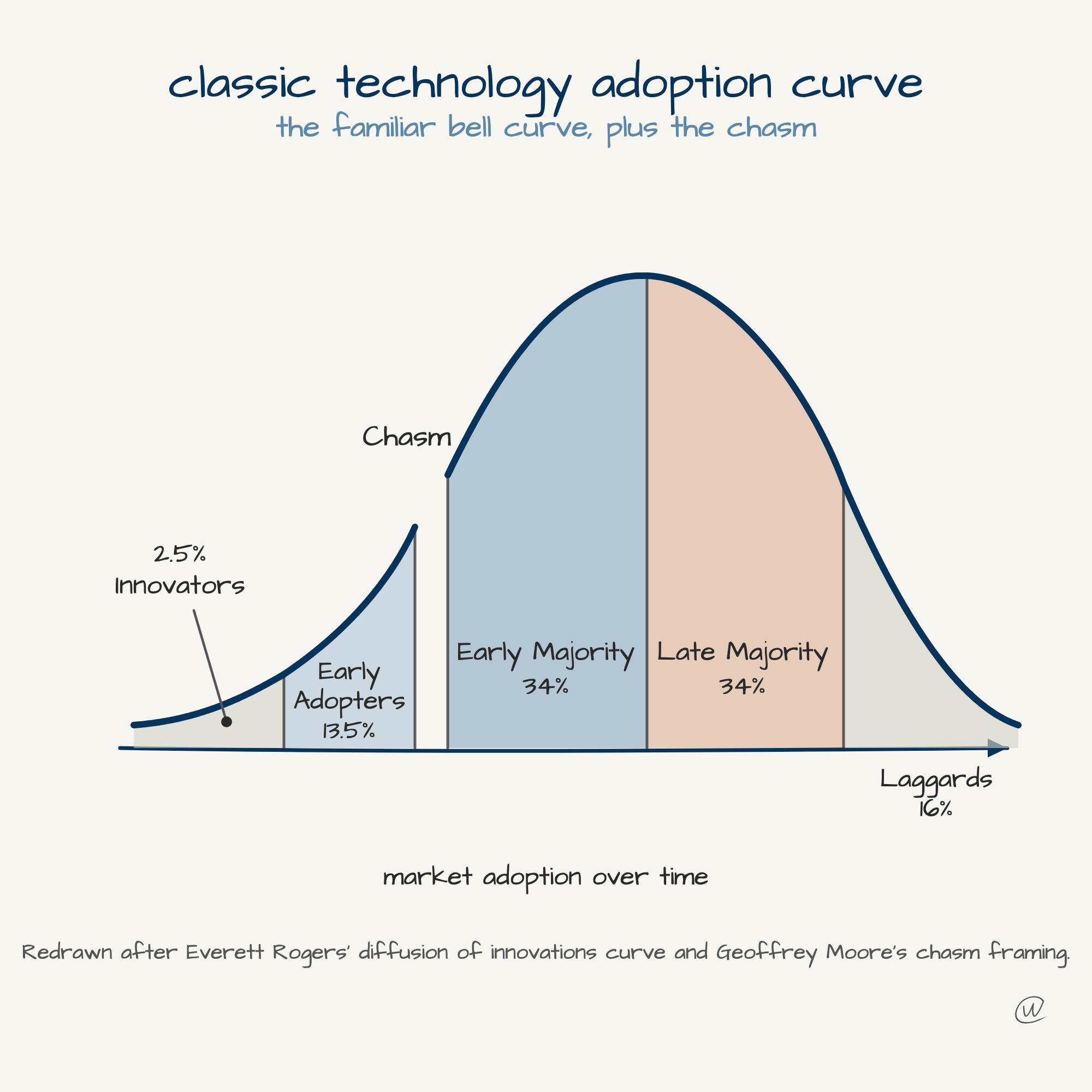
The standard technology adoption life cycle is usually drawn like a bell curve.
Innovators. Early adopters. Early majority. Late majority. Laggards.
Everett Rogers gave us the diffusion of innovations framework. Geoffrey Moore gave business people the language of Crossing the Chasm.
That curve assumes the thing being adopted is mostly stable. AI does not behave that cleanly.
A person who starts today is not starting where early adopters started in late 2022 or early 2023. They are starting with a tool that is more capable, more patient, more context-aware, more agentic, and more willing to tell you when it is uncertain.
The people who began early got the magic and the mess together. They learned prompting, scaffolding, harnesses, evals, memory tricks, retrieval patterns, context management, tool routing, and all the weird little practices that made early systems useful.
The person starting now gets a smoother on-ramp. That is great, and also a little annoying.
There is a strange fatigue among people who have been building with this stuff the whole time.
Every few months, a workaround becomes a checkbox. A harness becomes a native behavior. A prompt pattern becomes something the model simply does.
Then someone new walks up, tries the latest model, and assumes this is where the technology started. They do not see the months of brittle glue code, the agents that worked beautifully until the model changed, or the workflows that became obsolete because the model learned to do the work directly.
More like watching someone start a video game with all the patches already installed, then tell you the boss fight is easy.
They are not wrong. It is easier now.
But it was not easy the whole time.
I have said this before, and I believe it more now.
We are not simply adopting AI.
AI is the first technology that is adopting us.
The microwave did not learn from our cooking habits. The microwave did not redesign its interface every quarter because people were bad at leftovers.
The printing press did not get better at writing, editing, distribution, and audience while society was deciding what to do with it. Even the internet, for all its speed, did not become a different kind of machine every few months in the way these models have.
ChatGPT launched on November 30, 2022. In less than four years, the thing in front of us has become almost unrecognizable from the thing most people first tried.
People find the brittle edges. Labs see the patterns. The next model absorbs more of the scaffold that users had been building around it. Then the next group arrives and experiences the improved version as the baseline.
A lot of today's tricks of the trade will probably disappear into the product.
Harnesses, eval loops, explicit goal-setting, long-running agent scaffolds, and little process wrappers exist because the model still needs help knowing what kind of work it is doing. You still have to tell it, in some cases, that this is not a quick answer. This is a longer effort. It needs to hold a goal, inspect the work, revise, and keep going.
Within a year, many of these scaffolds may become the natural way AI interacts with humans. What feels like expert behavior today becomes default behavior tomorrow.
The adoption curve is still useful because people move at different speeds, and organizations still have politics, budgets, habits, risk tolerance, and fear.
AI adds a second curve underneath the first one. Human adoption is one curve. Model capability is another.
For most technologies, capability improves slowly enough that we can talk about adoption as if the thing being adopted is mostly stable. With AI, capability is rising while adoption is happening. The product is changing. The interface is changing. The cost of trying is changing. The amount of expertise required is changing.
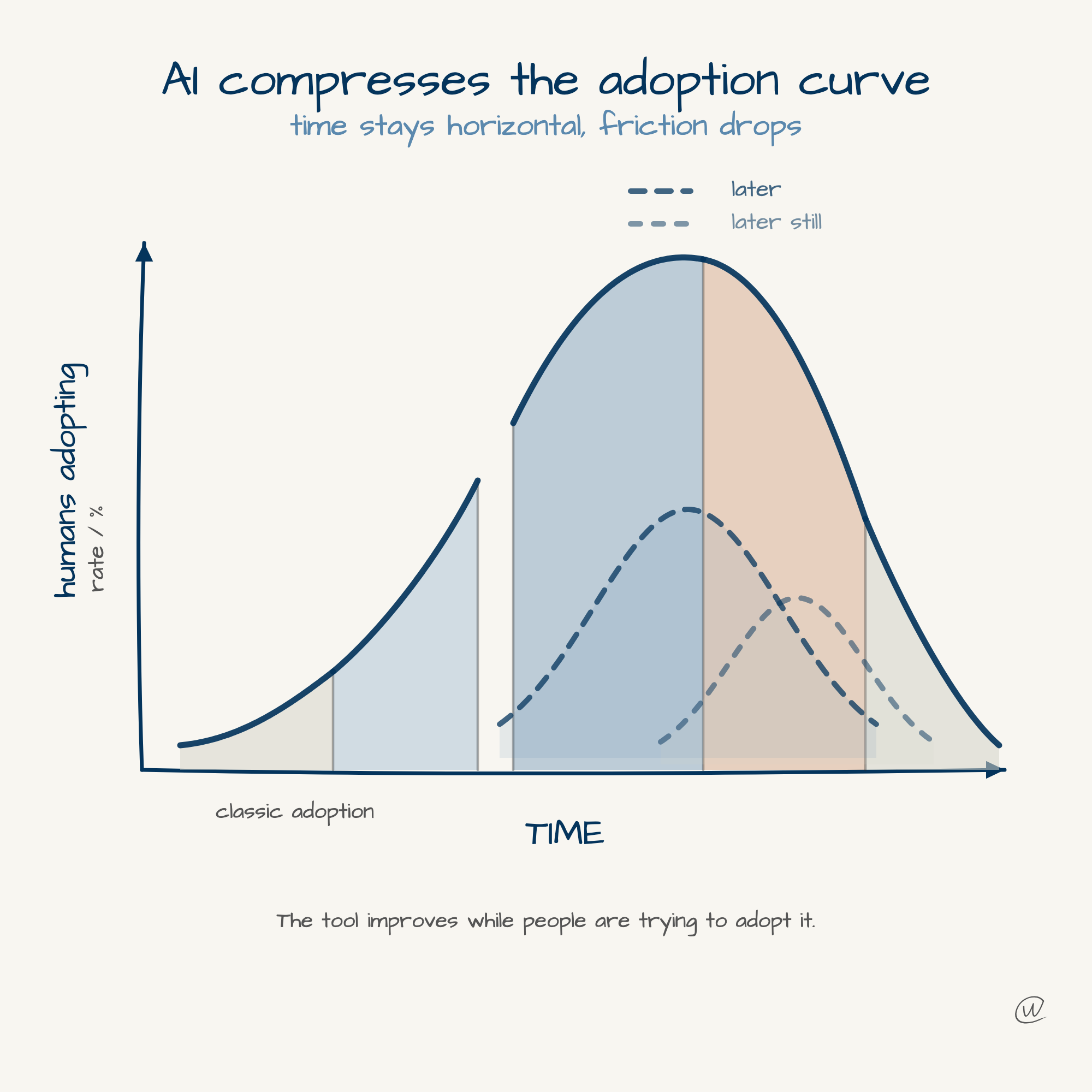
The late adopter may not be late in the usual way. They may be arriving after the hard parts have been abstracted away.
The early adopter may not have a permanent advantage unless they keep translating their scars into better judgment. The early work still counts, but not because the tools stay hard. It teaches you what changed.
Opus 4.8 did not make AI suddenly useful. That happened earlier.
It made the moving curve more visible.
The curve is not waiting for us to adopt AI.
It is moving toward us, and every time it moves, the next person starts a little closer to the future than the last one did.
Get More Where This Came From
Weekly AI frameworks and data strategy for people who have to make the call.


