From the Newsletter
AI Agents Need Real-Time Data
Google is putting agents inside Search. Now the boring facts have to be current enough to use.

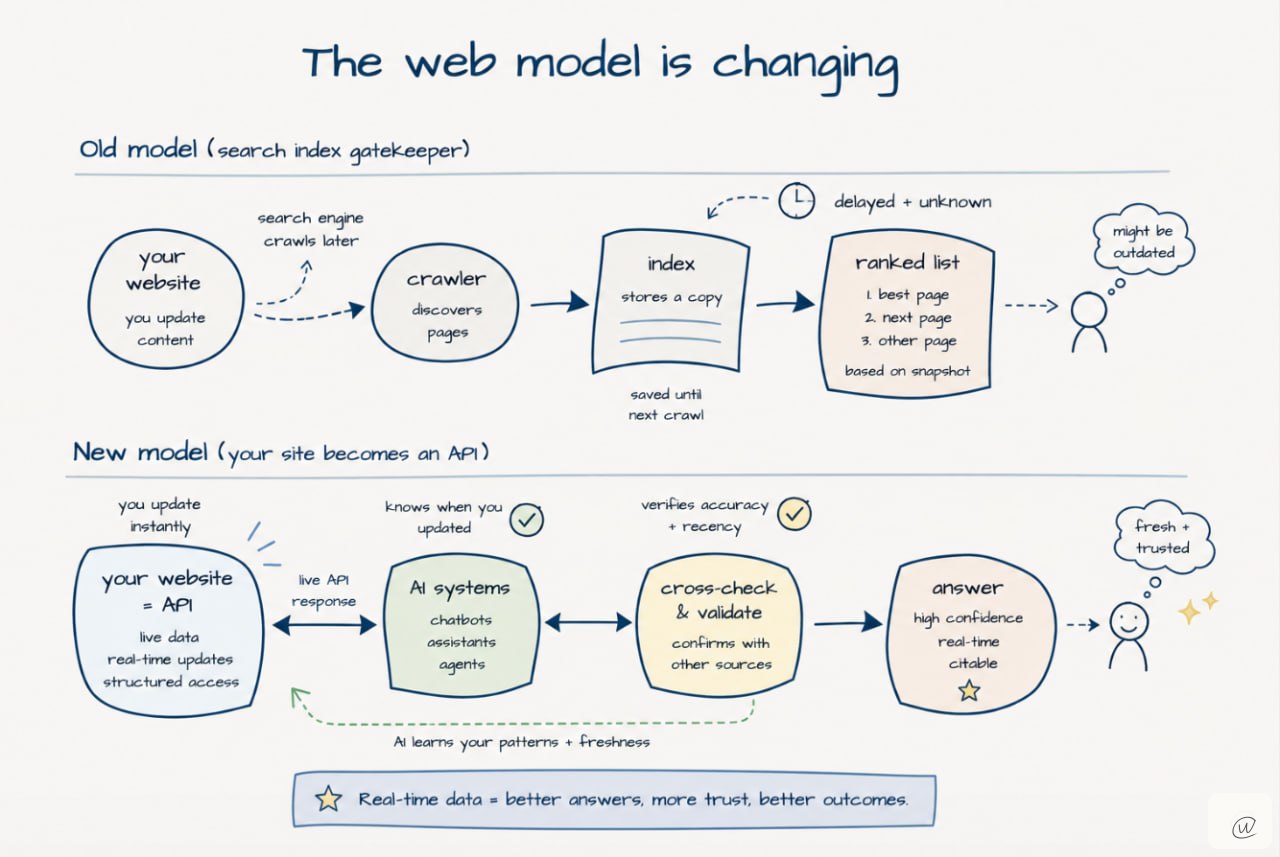
Search was built on a simple loop.
Crawl the page. Rank the result. Let the person decide what to trust.
That worked because the person did the last mile.
If a page looked stale, you opened another tab, checked the date, called the store, or tried a different result.
The index could be late because the user still had room to catch the gap.
IndexNow improves that loop. It lets a site tell search engines when content was added, updated, or deleted.
But it is still a request to recrawl a page.
AI agents need something different. They need to check the live system when the answer depends on current state.
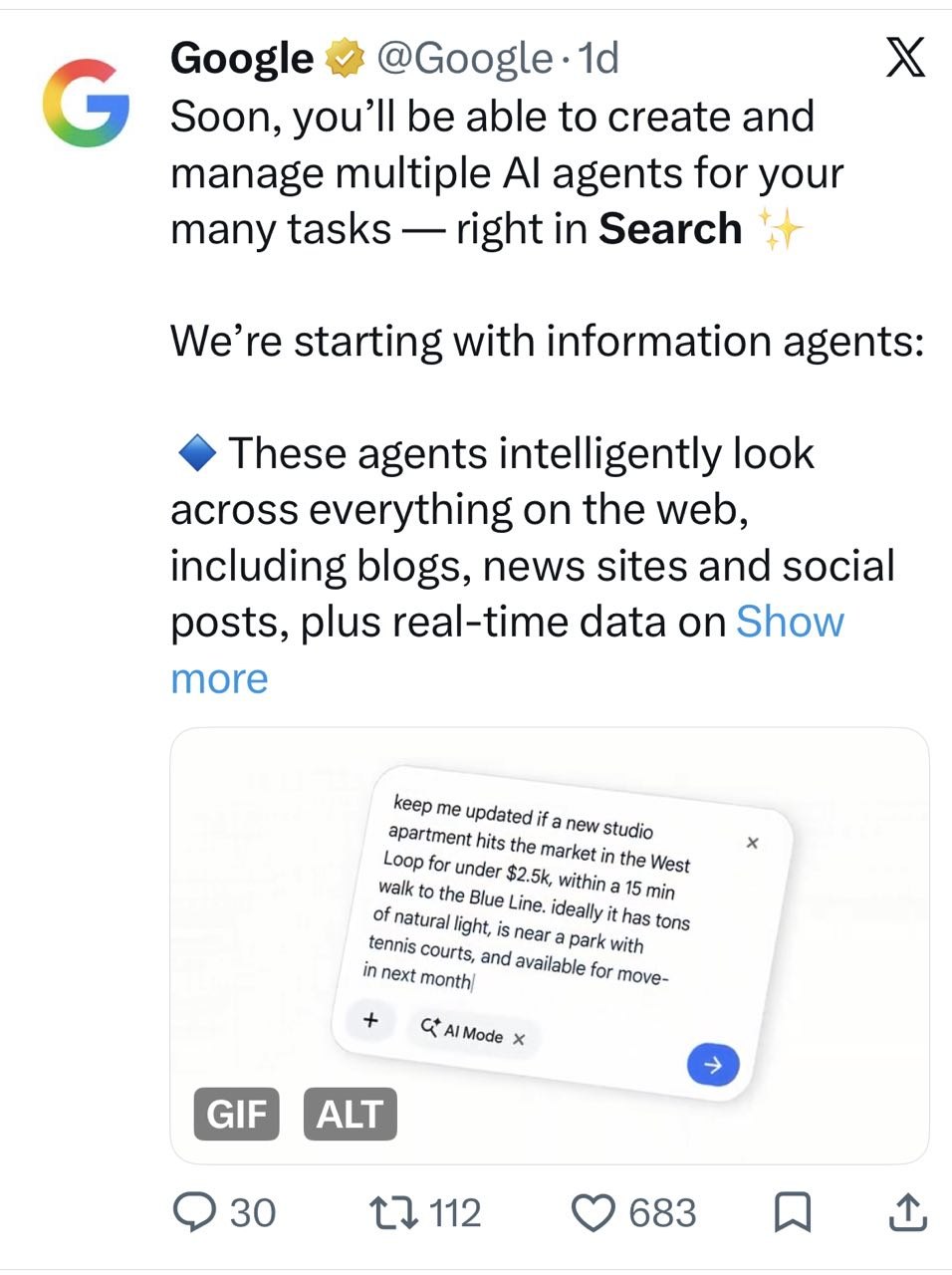
At Google I/O 2026, Google said Search is moving toward agents people can create and manage directly inside Search. The first version is information agents that work in the background and pull from blogs, news, social posts, and real-time data.
The useful source will not always be the best-written page.
It will often be the source that knows what changed.
Your website starts to become an API for reality.
Is the appointment open? Is the table available? Is the store busy? Is the offer still valid? Can this item arrive before Friday? Is this price safe to quote?
A static page answers what was true when someone updated it.
A real-time system answers what is safe to act on now.
AI agents reduce the cushion that made stale pages tolerable.
When an agent books, recommends, routes, orders, compares, schedules, or answers directly, stale data is not just a weak result.
It becomes the failed appointment, the wrong menu, the bad delivery promise, the expired offer, or the confident recommendation that sends someone to a closed location.
In Grounding Needs To Know When Facts Expire, I argued that a sourced fact can still be stale.
A citation tells you where something came from.
It does not tell you whether the fact is still alive.
AI does not just need better sources. It needs to know how fast the world around the source is moving.
Real-time information has always mattered when the decision mattered.
D-Day is the clean example.
The upcoming film Pressure, starring Andrew Scott as meteorologist James Stagg and Brendan Fraser as Eisenhower, focuses on the 72 hours before Normandy.
The plan said June 5.
The weather said wait.
Weather observations from western Ireland on June 3 warned Allied forecasters about an approaching storm, according to the Royal Meteorological Society.
Stagg then identified a narrow break for June 6. At 4:30 in the morning on June 5, Allied commanders met again, saw that the pressure was holding, and decided to go.
The calendar was accurate. The tide tables were accurate. The invasion plan was real.
The live condition changed the decision.
The business version is less dramatic, but it is everywhere.
A doctor’s appointment is open, or it is not. A restaurant table is available, or it is gone. A hotel room, service slot, delivery window, repair truck, inventory count, event ticket, and retail offer all live inside time.
The old internet treated many of these as page problems.
The page said appointments were available. The calendar had filled.
The page said open. Staffing, weather, construction, or local conditions had changed.
The page showed inventory that was true at 9:00 and wrong by 9:07.
Humans worked around that gap.
Agents will expose it.
As people let agents act for them, the difference between live answers and static pages will be harder to hide.
The agent will try to find the appointment, book the table, route around the delay, pick the location with live inventory, and choose the offer that fits the moment.
Companies with live data will look available, responsive, and trustworthy.
Companies without it will look absent at the moment of action, even if their marketing is polished and their historical data is correct.
Search rewarded pages that could be found.
Agentic systems reward businesses that can be queried.
The winners will expose current state, freshness, availability, confidence, and expiration in forms machines can safely use.
The next layer is time.
A static record tells you what happened. A trend tells you what is changing. A forecast tells you where the line may go next.
Acceleration tells you whether the change itself is changing.
Most business systems are still proud of the first layer.
AI agents will need the fourth.
Real-time data is not about updating every fact every second.
It is about giving every fact a time model.
Some facts are stable. Some decay slowly. Some expire as soon as the customer acts. Some only become useful when you can read the slope.
Brands that can show what is true now will beat brands that can only describe what used to be true.
Get More Where This Came From
Weekly AI frameworks and data strategy for people who have to make the call.


