From the Newsletter
The AI Multiplier on Your Career
Why adoption is not proficiency, and why the next five years widen the gap between operators and the middle.

I started at Salomon Smith Barney in 1997, straight out of school. First in public finance, then in institutional equity research.
I was twenty-two years old with no relationships in the business. The people around me had been making calls for a decade, and I needed a better way to find prospects than cold-calling out of a directory.
The internet was just getting started. It gave me a way in.
I used Yahoo and its early directories to prospect small trust banks across the United States for our electronic trading systems. Most of my colleagues could not figure out how I was finding that information at scale.
I had taught myself how to scrape the pages and build prospecting lists.
It was because I was willing to put the time in outside of work to understand how the internet was digitizing contact information. That one shift in approach helped me scale so far that I ended up teaching my mentors how to do the same, or at least helping them get the data into their spreadsheets.
The Job Is the Job
Half of what makes you good at your job, you are not doing on the job. The job is the job.
Learning happens outside of the job.
The question is whether you have the agency and the curiosity to spend a weekend, or four nights in a row, teaching yourself something the people around you have not yet figured out.
We are now in a time where your ability to learn AI outside of your day job is the most important thing you can do for your career. Gallup just confirmed that half of employed Americans already use AI at work.
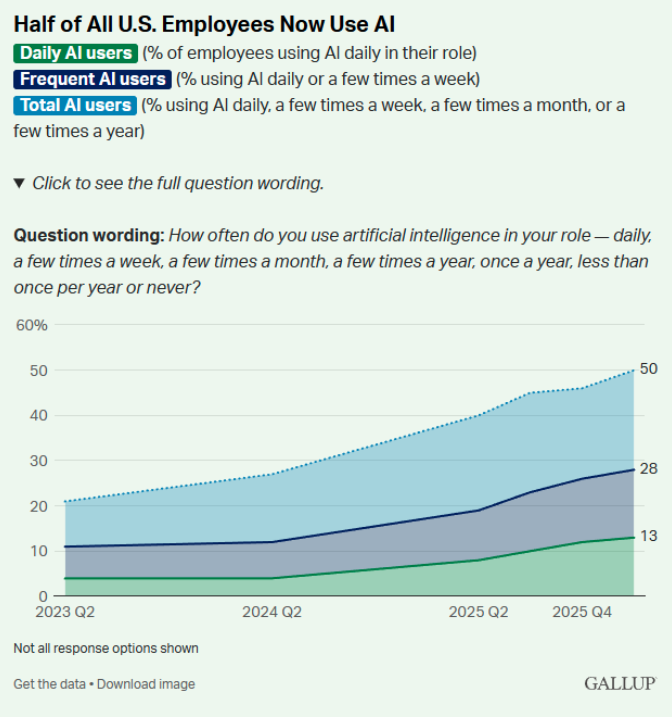
Adoption doubled since 2023. The Gallup number is the floor, not the ceiling. The real question is what people do with that access.
Tails, Not Normal Curves
This may be an oversimplification, because the tail of AI adoption is not a real normal curve. Still, let’s assume a normal distribution of workers for a moment.
You have people ranging from very low output to very high output, with average workers piled up in the middle. We have all put in different amounts of effort at different times. Generally speaking, it looks normal.
AI is reshaping this the way the internet did, and the way every major technological advancement has. It comes in waves, and two possibilities stand out for what happens next.
One possibility is that AI stretches everything out. More people fight the new technology and fall further toward low output, while the tails stretch in the other direction and everyone who adopts gets a little more high output.
The second possibility, which I think is more likely, is that the people who are left behind never adopt this stuff at all. Most workers see little change, and a few people scale insanely with AI.

That is my prediction. It might be a rational one, given how this pattern has played out with every technological advance I have lived through.
The only difference this time is that instead of people adopting the technology, the technology feels like it is adopting us.
Andrew Chen said it plainly this weekend. AI is a multiplier, not an equalizer, and the biggest gains go to the people who are already good at their jobs.

Last week I wrote about the second brain I have been building for quite some time. I have always been a conscientious note-taker, but I have long wanted to multiply that effect. AI is helping me do it.
If you want to read exactly how I did this, the full story is in The Second Brain Finally Works.
That is exactly what this curve stretch is all about. What voice transcripts, entity identification and extraction, and knowledge graph linking have done is make my notes feel almost like a living second brain.
People have talked about this idea for a long time, but it has always been an enormous amount of work. Seven to nine years of notes can be tough to process. Now it is working.
I also talked about access to knowledge and learning in schools. I flagged this a few weeks back.
I think every child has a chance to be amazing at math. Unfortunately, not every math teacher is amazing at teaching it. That is where Math Academy comes in, and I wrote about it in Comics, Algebra, and Our Kitchen Table. I want to stress the main point one more time.
Equal access is not equal utility
A child with access to an elite AI tutor still needs a parent, teacher, or peer who models curiosity. Access opens the door. Agency walks through it.
The Human Traits That Survive
McKinsey’s Skill Change Index this week put negotiation, judgment, framing, and leadership at the top of the list of what will matter most over the next five years.

Those are human traits. They have always mattered, and they will keep mattering.
The more technology automates the grinding, the more humans have time for connection.
Looking back across my own career, human connection was the thing that opened the doors. Every door.
The more time you put into learning how to work with new technology, the more you can share what you have learned with the people around you. Sharing is where most real human connection at work comes from.
One of the more durable lessons I have learned is this one. People want more time with the people they love. If you can show them how new tools give some of that time back, they will remember you for it. You enabled them.
That is a good place to be.
I cannot say this strongly enough to my own kids, with one of them close to finishing college. AI tools are becoming a force multiplier for their generation. But only to the extent that they are willing to learn the tools and teach other people how to use them.
If you are thinking about finance, learn how to use Claude inside Excel in a way that scales every problem you will run into. If you are thinking about law, learn how to work with legal Claude on contracts without turning too much of the work over to it. Every industry has its own version of that lesson.
A Warning About Shortcuts
AI can feel like a shortcut, but it is not one.
On April 18, the Financial Times reported that Sullivan and Cromwell filed a bankruptcy petition for Prince Global Holdings stuffed with AI-hallucinated case citations. Andrew Dietderich led the filing, and Judge Martin Glenn cataloged about three pages of specific errors.

Boies Schiller Flexner, the opposing counsel, spotted the fabrications. This is one of the most expensive bankruptcy practices in the country, and Dietderich himself advised OpenAI on its restructuring.
If the lawyers counseling the AI labs are submitting filings with fabricated precedents, the rest of the professional services market is not going to be far behind.
That is the other side of the multiplier. When people reach for AI as a shortcut instead of a force to lean into, it breaks them in public.
A strong lawyer with strong AI discipline becomes a ten-person practice of one. A strong lawyer with sloppy AI habits becomes the headline and the sanction.
I have been saying this to my kids, to the mentees I work with, and to anyone who asks.
Smart use cases, dumb use cases, and no shortcuts
There are smart uses and there are dumb ones. The discipline is knowing the difference before it shows up in a court filing. AI is a force multiplier. It is not a shortcut.
Get More Where This Came From
Weekly AI frameworks and data strategy for people who have to make the call.


