From the Newsletter
Six Decades of the End of the World
Things humanity was supposed to die from during my lifetime.

Ice age. Nuclear war. Y2K. Peak oil. The Mayan apocalypse. And now AI.
We've had a fairly demanding schedule.

I started putting these into a list because the repetition is funny. In my brief five decades, I've lived through parts of six decades' worth of warnings about how this all ends. Some involved very real dangers. Others gave the end of the world a date and then had to watch everyone go to work the next morning.
Jacob Coxon's resignation from Anthropic gave the latest entry a very public argument to go with it. A researcher warns that the companies building AI are gambling with our lives. Elon Musk calls it a setup. The researcher answers him. We can read the exchange on X while the story is still taking shape.
The warning, the amplification, the demands for restrictions, the fight over who gets to be believed. We can follow all of it, including the point where being afraid becomes a reason to give someone more control.
We've had plenty of practice with the fear part.
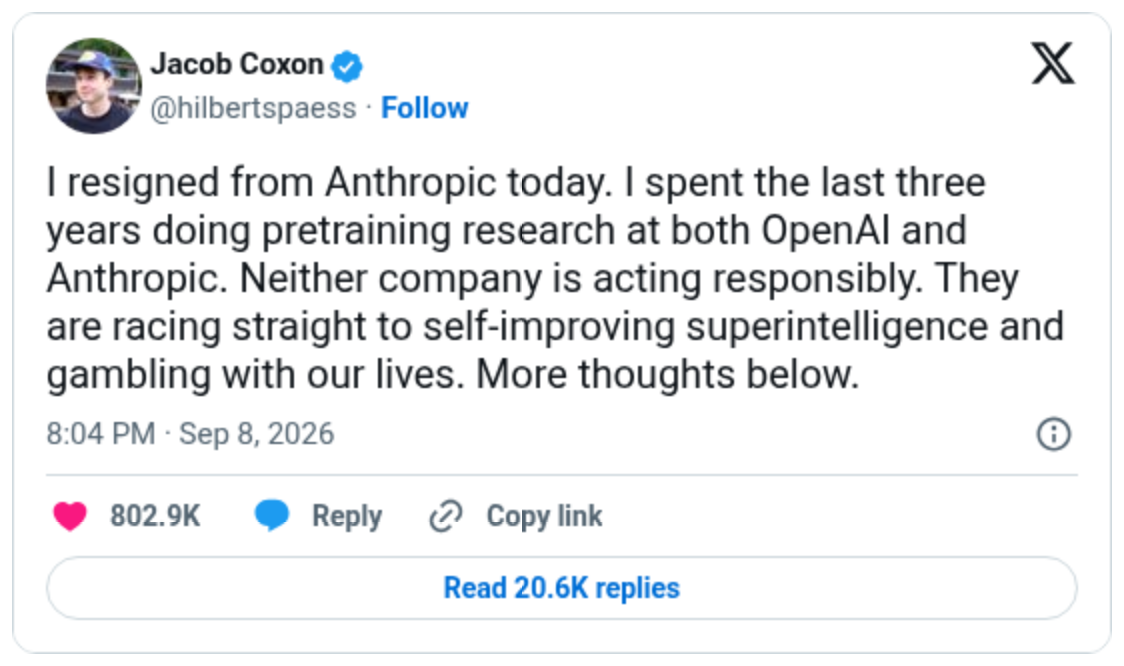
Coxon announced his departure in a seven-post thread on X, saying he'd spent three years doing pretraining research across OpenAI and Anthropic. He accused both companies of acting irresponsibly as they pursued self-improving superintelligence. Ars Technica covered the resignation and his warnings.
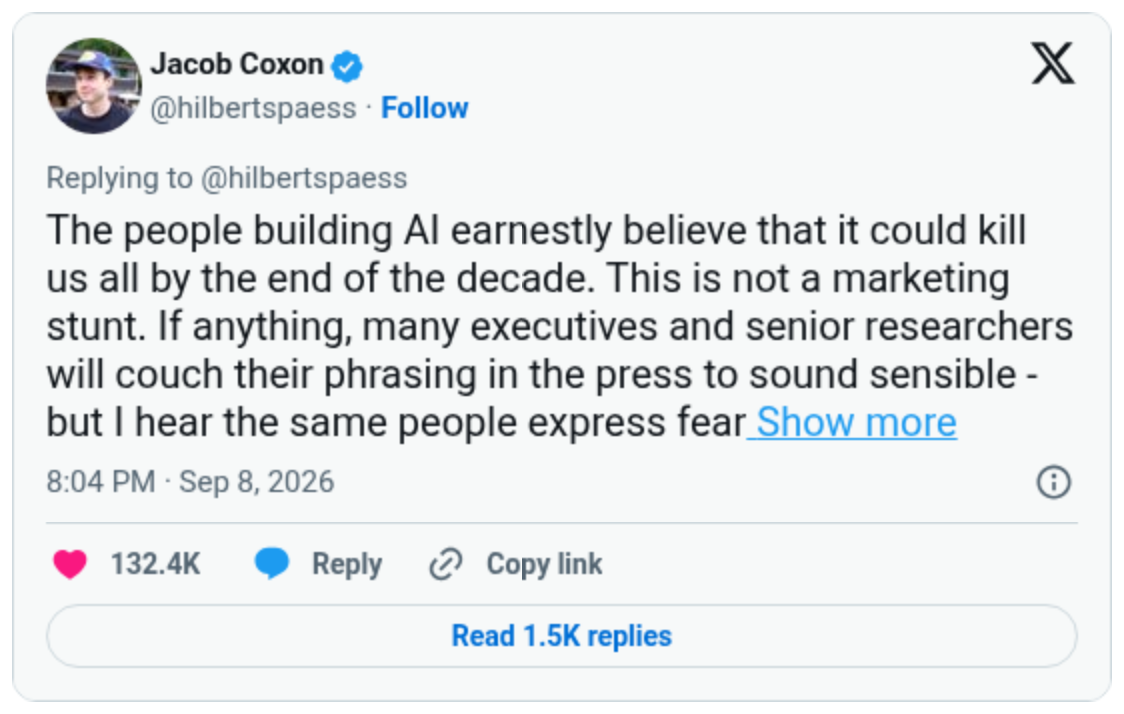
His third post said the people building AI believe it could “kill us all by the end of the decade.” He added, “This is not a marketing stunt.”
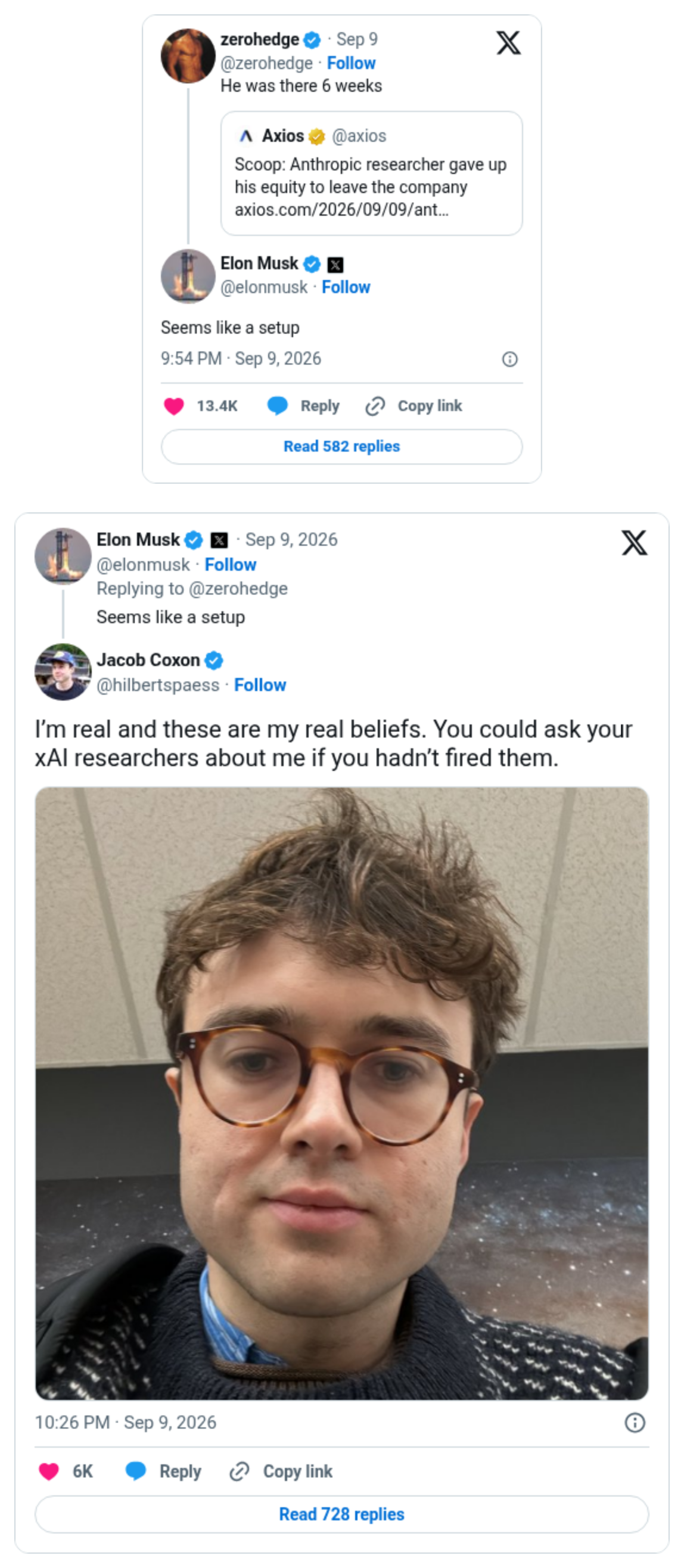
Forbes reported Musk's “Seems like a setup” response and his later suggestion of a “psy op.” The setup reply came on September 9, in response to ZeroHedge's “He was there 6 weeks.” That's the claim Musk was answering. Forbes relayed Axios's reporting that Coxon had been at Anthropic for about four months and left before his stock options vested.
Coxon answered Musk directly.
"I'm real and these are my real beliefs. You could ask your xAI researchers about me if you hadn't fired them."
Tim Sweeney questioned whether the posts and reactions were choreographed. Bill Ackman amplified a claim of an organized PR effort. David Sacks suggested pausing Anthropic's IPO until the claims could be investigated. Those were their reactions, reported by Forbes, which described the conspiracy claims as unsubstantiated. Other AI researchers publicly supported Coxon's concern.
What interests me is how quickly the argument moves from a frightening prediction to what the rest of us should agree to. Coxon's sixth post raises the possibility of a temporary ban on improving model capabilities. That's a specific restriction, attached to a warning about our survival. We can examine the whole argument, including the point where we're asked to hand someone the authority to stop other people from building.
Before we get to that, a short tour of the previous appointments with extinction.
Some risks were real, including nuclear war and ozone loss, with ozone recovery on track for 2040 to 2066 depending on the region, if current policies remain in place.
| Decade | Fear | Who pushed it (outlet or person) | Link |
|---|---|---|---|
| 1970s | The coming ice age | Peter Gwynne in Newsweek (1975) | Newsweek retrospective |
| 1970s | The Population Bomb | Paul Ehrlich, examined by Charles C. Mann in Smithsonian | Smithsonian account |
| 1970s | Killer bees | TIME (1972) | TIME coverage |
| 1980s | Nuclear winter | Carl Sagan in Parade and the TTAPS team in Science (Turco, Toon, Ackerman, Pollack, Sagan) | Smithsonian account |
| 1980s | Acid rain | TIME (1984) | Turning Green into Yellow |
| 1980s | The ozone hole | Joe Farman, Brian Gardiner, and Jonathan Shanklin in Nature (1985) | Nature paper |
| 1990s | Y2K | TIME (1999) | TIME article |
| 1990s | Mad cow disease | The New York Times (1996) | New York Times report |
| 2000s | Peak oil | WIRED (2005) | WIRED article |
| 2000s | SARS | WHO (2003) | WHO global alert |
| 2000s | Bird flu | UN News (2005) | UN News warning |
| 2000s | Swine flu | WHO (2009), with overall severity described as moderate | WHO pandemic declaration |
| 2000s | An ice-free Arctic in summer | Al Gore, reported by AP (2009), with his office later qualifying the claim as nearly ice-free | AP report |
| 2010s | The Mayan apocalypse | BBC (2012), reporting skeptically | BBC coverage |
| 2010s | Twelve years left | The Guardian's headline framing of the IPCC report (2018) | Guardian article |
| 2020s | AI doomerism | Eliezer Yudkowsky in TIME (2023) | TIME essay |
I'm poking fun, but I'm also serious. These dangers weren't all equivalent, and surviving them doesn't mean nothing happened. People suffered. Some forecasts failed. Some warnings prompted work that helped. The Mayan calendar and nuclear war don't deserve the same level of concern just because they fit on adjacent book spines.
But I don't think we should have to prove that a danger is imaginary before we're allowed to question what someone wants to do about it.
That's where fear becomes useful to people seeking control. Tell people the alternative is catastrophe and an enormous intervention starts to sound reasonable. Question it and you can find yourself having to explain why you supposedly don't care whether everyone dies. Meanwhile, the person proposing the intervention gets less scrutiny than the person asking whether it would work.
The population-control history shows why that worries me. The ozone response shows that we can identify a problem and make progress on it. Both belong in this argument. So does the difference between understanding a technology and letting hype or fear make the decision for us.
With AI, we can read the proposed restrictions for ourselves. Coxon raises a temporary ban on improving model capabilities. Yudkowsky's essay went as far as contemplating airstrikes against data centers violating a proposed moratorium.
Airstrikes. To protect us from what the computers might do.
I'd like people to spend at least as much time examining that proposal as they spend forwarding the prediction that supposedly justifies it.
Mass persuasion through fear is older than I am, and it certainly shows no sign of slowing down. What changes with X is that we can follow Coxon's words, Musk's response, Coxon's answer, and the people trying to turn the exchange into support for their own position. We can compare the original claim with the headline and see what gets added along the way.
I think AI doomerism is the first time we can watch the psyop unfold in real time on X. We're watching fear-driven persuasion play out in public, and we can inspect the demands attached to it.
Before agreeing to a ban, a new authority, or another supposedly unavoidable response, I'd like an answer to a fairly ordinary question.
What, exactly, are you asking us to let you do because we're afraid?
It's amazing what you can control when people are afraid.
And, of course, there's the classic doomer comeback to my skepticism.
"Yeah, but this time, it's for REAL!"
Whatever.
Get More Where This Came From
Weekly AI frameworks and data strategy for people who have to make the call.


