From the Newsletter
The API Is the UI Now
Why one company killing their UI and another letting anyone conjure a UI in seconds point at the same consumer reality

The disappearing UI thesis I wrote about last year is arriving faster than the timeline I gave it.
When I first mapped the shift, I was calling out a pendulum. The data was about to swing ahead of the interface.
Two announcements inside 24 hours just proved it.
Salesforce told everyone the API is the UI. Anthropic told everyone anyone can conjure a UI by talking to Claude.
One company abandoned the per-seat screen as the model for data, and the other launched a tool that builds whatever interface a consumer wants in seconds.
Marc Benioff posted from Salesforce yesterday.
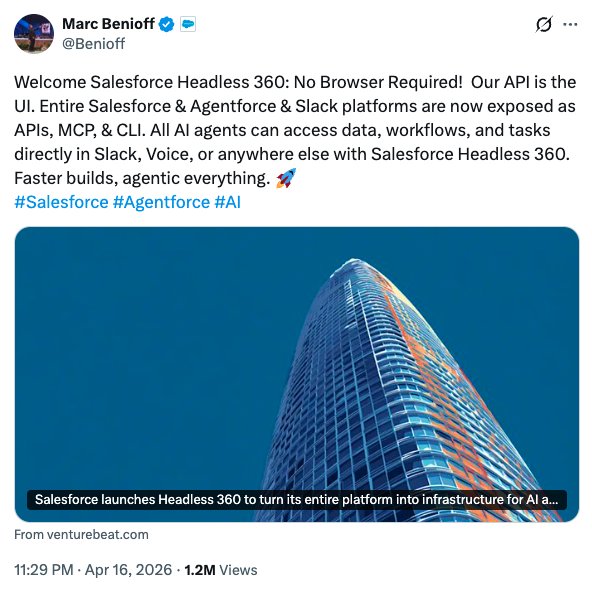
Headless 360 exposes the Salesforce, Agentforce, and Slack platforms as APIs, MCP, and CLI. No browser required. AI agents get the data, workflows, and tasks directly.
The screens stop being the product, and the calls behind them become the product.
A few hours later, Anthropic shipped Claude Design.
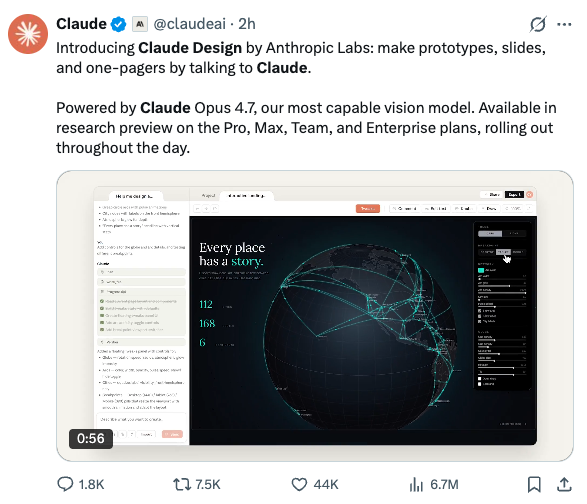
A user talks to Claude and gets back a prototype, a slide, or a one-pager.
The UI is no longer something a product team spends a quarter designing. It is something a consumer asks for in a sentence.
The two moves describe the same consumer reality from opposite ends.
One enterprise vendor removes the interface on the way to the data. One AI vendor lets an individual spin up whatever interface fits the moment.
Neither one asks the user to sit in a predesigned screen any longer than the task itself takes.
Apple is pointed the same direction, opening Siri to third-party models so whichever layer builds the best answer can plug in. Keith Rabois made the same call on Lenny's Podcast this week, arguing the traditional UI layer is collapsing. Google's Think with Google team has been writing about how question, consideration, and purchase collapse into one AI-mediated moment inside AI search.
I covered the front edge of this in Conversational Interfaces Break Jakob's Law. A year later, the pattern is not coming.
It is shipping.
Many brands still underestimate how much the query itself has changed.
A decade ago a search engine guessed intent from location, device, and rough demographics. The model today carries a knowledge graph about the person asking, with car model, kids' ages, allergies, and loyalty programs all in context.
The consumer is sending a keyword plus a profile they have built and can edit.
Brands designing around keywords and impression counts are running a cycle behind the consumer.
Real-time eligibility is the second piece that breaks a prior assumption.
Ad auctions assumed scheduled inventory and bid tables, but the model wants a correct answer right now.
If your pricing, availability, and service windows are not available on the spot, you drop out of the consideration set even when the consumer wants you there.
The Trust Paradox
Humans feed enormous amounts of data to the machines, and the machines compute what to trust from that data and build rules to rank it. Humans then ask those same machines for answers, and the machines return what they flagged as trustworthy. Humans decide whether to believe the response, and the response rests on data humans supplied in the first place.
Where this comes from
The machinery behind that loop is not new. Wang and Strong laid out the dimensions in 1996 — consistency, recency, frequency, reputation, authority — and algorithms still lean on them.
A brand can influence some of those, and others sit outside its control. What has changed is velocity.
The loop between data publication, machine judgment, and consumer queries used to run over weeks, and now runs in seconds.
Consumers trust AI recommendations and still verify before acting.
That verification step is the Trust Paradox playing out in daylight. The consumer is scanning for consistency across surfaces, recency of the facts, and reviews as reputation, all within seconds.
If the independent check contradicts the AI, the brand loses credibility with the human, and the model starts to down-weight the source it cited.
Memory compounds this effect.
When the AI makes a recommendation, it writes that claim into the consumer's memory graph, and if your brand never lands in that graph, the next prompt filters you out before the question is asked.
Classical search at least gave me an impression loss I could find in the logs, while generative answers leave no referrer and no log to pull.
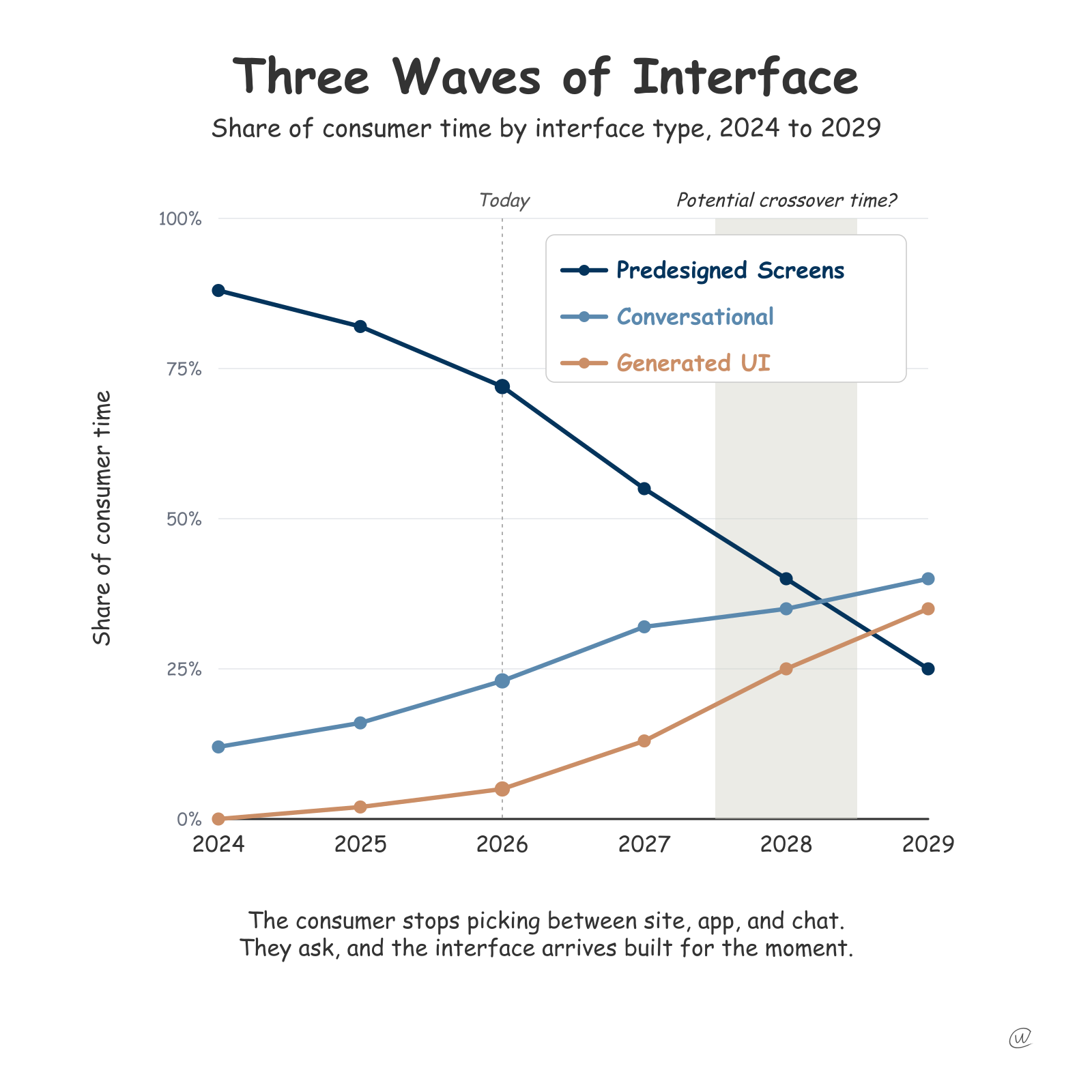
Here is what I expect over the next several years. I mapped an early version of this in The Data-UI Pendulum, and a year on the curve is steeper than I drew.
Predesigned screens, the websites and apps we have been optimizing for two decades, drop from the dominant interface to a minority surface by 2029.
Conversational UI rises quickly, plateaus, and becomes the baseline for how consumers start most tasks.
Generated UI, the one-shot bespoke interface Claude Design previewed this week, goes from roughly zero today to a material share of consumer time by 2028.
The consumer stops picking between a site, an app, and a chat. They ask the model for an answer and the interface arrives built for that moment.
The brands clearing this are keeping one version of the facts across every surface and updating them when reality changes. That single source has to feed both Human Trust and Algorithmic Trust.
The consumer asks the model, the model answers from your brand knowledge, the consumer verifies against that same brand knowledge on your own surfaces, and the loop closes instead of cracking.
Where to put the effort. Stand up your own evaluation set of the prompts that matter to your category and check them on a cadence, because anyone not doing that is working from assumptions about the surface, shaping their demand.
Make eligibility callable, so pricing, availability, hours, and service windows return a correct answer right now and not after a crawl cycle.
Own the canonical entity, because the cleaner and more corroborated record wins the geography, with less averaging across sources.
That is the position the AI reaches for when it needs to be confident, and it is where the consumer's memory graph builds you in as the category.
Get More Where This Came From
Weekly AI frameworks and data strategy for people who have to make the call.


